Effective Sales Email Templates to Boost Your Outreach
Unlock the secrets to successful sales outreach with our guide to seven proven email templates. Learn how to implement AIDA, PAS, BAB, and more to boost your engagement and conversion rates. Avoid common pitfalls and apply these strategies to transform your sales process today!
Unlocking Sales Success with Powerful Email Templates
Boost your sales performance with proven email templates. This listicle presents seven effective sales email templates, including the AIDA framework, PAS (Problem-Agitate-Solve), BAB (Before-After-Bridge), ACCA, the 3x3 research-based personalization template, SPIN, and the Challenger template. Learn how these templates can improve your open and click-through rates, leading to more closed deals and increased revenue. Mastering these sales email templates is crucial for effective communication and achieving your sales goals. We'll also show you how quiky.email, a free AI-powered email writing tool, can streamline your personalization and sending process.
1. The AIDA Framework
The AIDA framework is a time-tested model for crafting persuasive sales email templates. AIDA stands for Attention, Interest, Desire, and Action. This structure guides the reader through a psychological journey, beginning with capturing their attention, then piquing their interest in your solution, creating a desire for your product or service, and finally, prompting them to take a specific action. Its enduring popularity stems from its adaptability across various industries and products, making it a valuable tool for sales email templates. This framework deserves its place on this list due to its proven effectiveness in driving conversions and its logical, easy-to-implement structure.
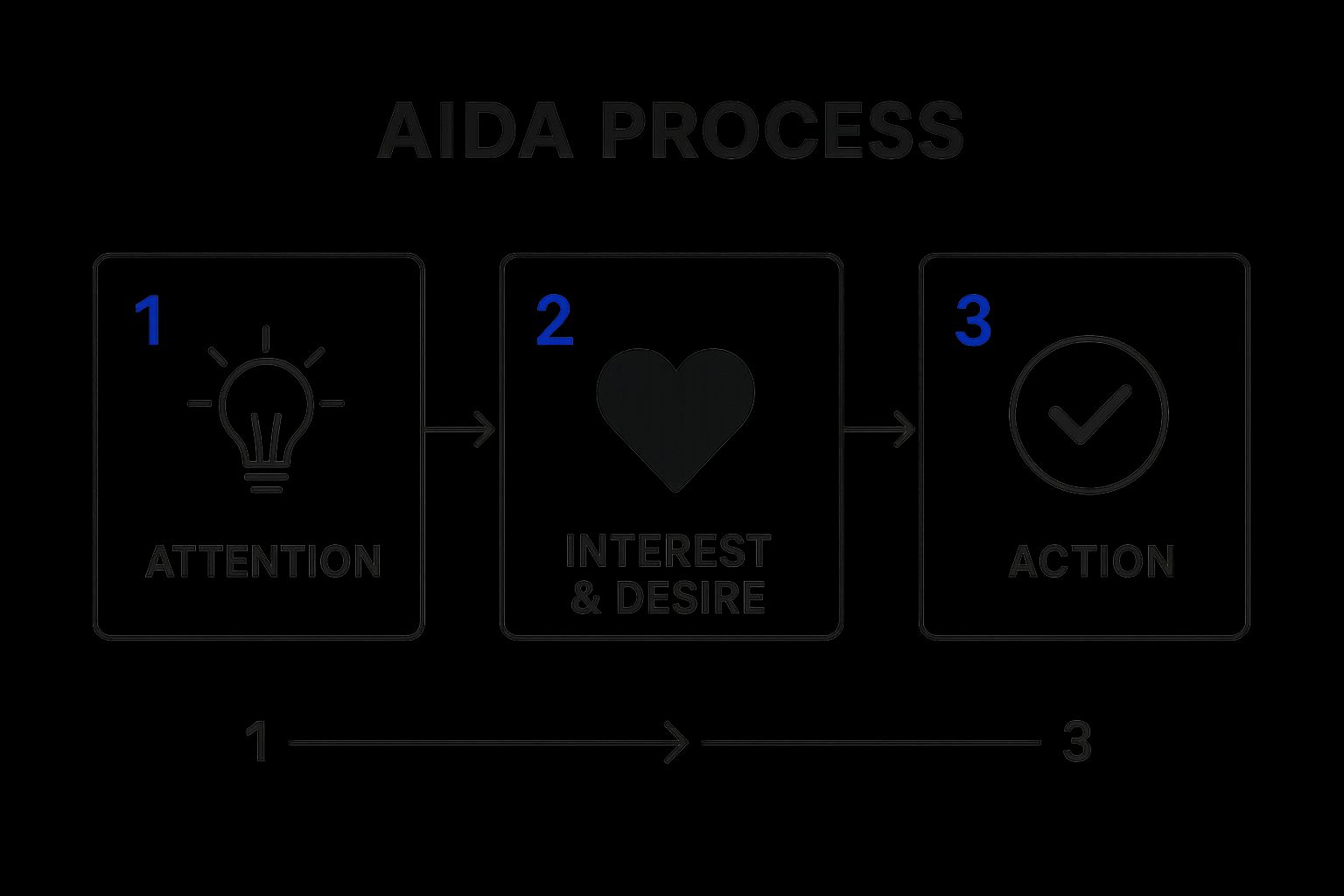
The infographic above visualizes the AIDA framework as a sequential, four-stage funnel. It illustrates the process of drawing a potential customer in with a compelling hook (Attention), providing information to hold their interest, fostering desire through benefits and social proof, and finally, motivating them to take a specific action. The downward-pointing funnel emphasizes the importance of each stage in moving the prospect closer to conversion.
This framework is highly effective due to its sequential structure, psychology-based persuasion techniques, and clear call-to-action component. The four stages work synergistically. First, you must grab the recipient's Attention with a powerful headline or opening line. Then, generate Interest by highlighting the relevance of your product or service to their needs. Cultivate Desire by showcasing the benefits and demonstrating value. Finally, prompt Action with a clear and compelling call to action. The sequential nature of this framework mimics the buyer's journey, making it a natural and persuasive approach to sales emails.
Example:
- Subject: [Attention] Cut your accounting costs by 35% in 90 days?
- Body: Starts with a compelling statistic or question to grab attention. The middle section explains how your solution works (Interest) and shares success stories (Desire). The email ends with a clear call to action like: "Book a 15-minute demo this week" (Action).
Pros:
- Proven effective for decades across industries.
- Creates a logical flow that guides prospects through the decision-making process.
- Easily customizable for different products and audiences.
- Strong focus on conversion at every stage.
Cons:
- Can feel formulaic if not personalized effectively.
- May be too direct for relationship-building in complex B2B sales.
- Sometimes seen as outdated in modern relationship-based selling.
- Can require a longer email length to execute each stage properly.
Tips for Implementation:
- Attention: Use the recipient's name and company information.
- Interest: Include industry-specific statistics and data.
- Desire: Share relevant case studies and testimonials.
- Action: Make your request specific and time-bound.
- Overall: Keep each section concise but impactful.
The AIDA framework is particularly useful when your goal is to generate leads, promote a specific offer, or drive immediate action. Learn more about The AIDA Framework. While powerful, it's important to personalize your emails to avoid a generic feel. In complex B2B sales where nurturing relationships is key, consider integrating AIDA principles within a broader, more personalized communication strategy. Popularized by Elias St. Elmo Lewis in the late 19th century and adapted by modern sales giants like HubSpot and Salesforce, the AIDA framework continues to be a relevant and effective structure for sales email templates.
2. The PAS Template (Problem-Agitate-Solve)
The PAS (Problem-Agitate-Solve) template is a powerful sales email template that leverages the psychology of pain points to drive conversions. It works by first identifying a specific problem that your prospect is likely facing. Instead of immediately presenting your product as the solution, you then "agitate" the problem by highlighting its negative consequences and amplifying the pain associated with it. This creates a sense of urgency and makes the prospect more receptive to a solution. Only then do you introduce your product or service as the answer to their woes. This delayed presentation makes the solution appear more desirable and impactful. This framework is highly effective for problem-aware audiences as it resonates with their existing challenges and offers a clear path to relief. Its emotion-driven narrative structure makes it more engaging than a simple feature-driven approach.

This sales email template earns its place on this list due to its proven effectiveness in capturing attention and prompting action. Its problem-centric approach, combined with a carefully crafted narrative, positions your offering as the logical solution, making it a valuable tool for driving sales. It works well for both short, concise emails and longer, more detailed ones.
Features:
- Problem-centric approach: The core of this template focuses on addressing a specific problem.
- Emotion-driven narrative structure: It uses emotional triggers to create a connection with the prospect.
- Delayed solution presentation: The solution is introduced only after the problem has been fully agitated.
- Urgency creation: By amplifying the problem's consequences, the template creates a sense of urgency for the prospect to find a solution.
Pros:
- Highly effective for problem-aware audiences: Resonates with prospects already experiencing the identified pain points.
- Emotionally engaging and relatable: Connects with prospects on a deeper level.
- Positions your offering as the logical solution: Naturally leads the prospect to see your product/service as the answer.
- Works well for both short and long-form emails: Adaptable to various email formats.
Cons:
- Can come across as manipulative if overdone: Requires careful and ethical implementation.
- Not ideal for positive-focused products/services: Less effective for products promoting joy or aspirational benefits.
- May not work for completely unaware prospects: Requires some level of existing problem awareness.
- Requires good understanding of prospect's pain points: Effective implementation necessitates thorough research.
Example:
- Subject: [Problem] Your team missing sales targets?
- Opening paragraph: Identifies a common industry problem, such as low conversion rates or inefficient sales processes. For example: "Are your sales reps struggling to hit their monthly quotas? In today's competitive market, closing deals is more challenging than ever…"
- Second section (Agitation): Amplifies the problem consequences: "This means missed bonuses, stalled growth, and potentially even job losses…"
- Final section (Solution): Presents your product/service as the answer: "Our sales automation platform has helped similar companies increase close rates by 27% and shorten sales cycles by 15%."
Tips for Implementation:
- Research your prospect's specific challenges: Don't rely on generic assumptions.
- Use industry-specific language that resonates: Demonstrate your understanding of their world.
- Avoid over-agitating to the point of being negative: Maintain a balance between highlighting pain points and offering a positive solution.
- Use social proof in the solution section to build credibility: Include testimonials, case studies, or data points.
- Keep the focus on the prospect, not your product features: Frame your product’s benefits in terms of how they address the prospect's pain points.
Popularized By: Dan Kennedy (direct response marketing expert), Ramit Sethi (in his sales emails for finance products), DigitalMarketer's email marketing templates
3. The BAB Template (Before-After-Bridge)
The Before-After-Bridge (BAB) sales email template is a persuasive writing technique that leverages the power of transformation. It works by first painting a picture of the prospect's current world ("Before"), often highlighting pain points and inefficiencies. Then, it presents a vivid vision of their improved reality ("After") with your product or service implemented, showcasing the benefits and desired outcomes. Finally, it "bridges" the gap between these two states by clearly explaining how your offering facilitates this transformation. This approach allows you to present your product not just as a feature-laden tool, but as the key to achieving a desired future state.
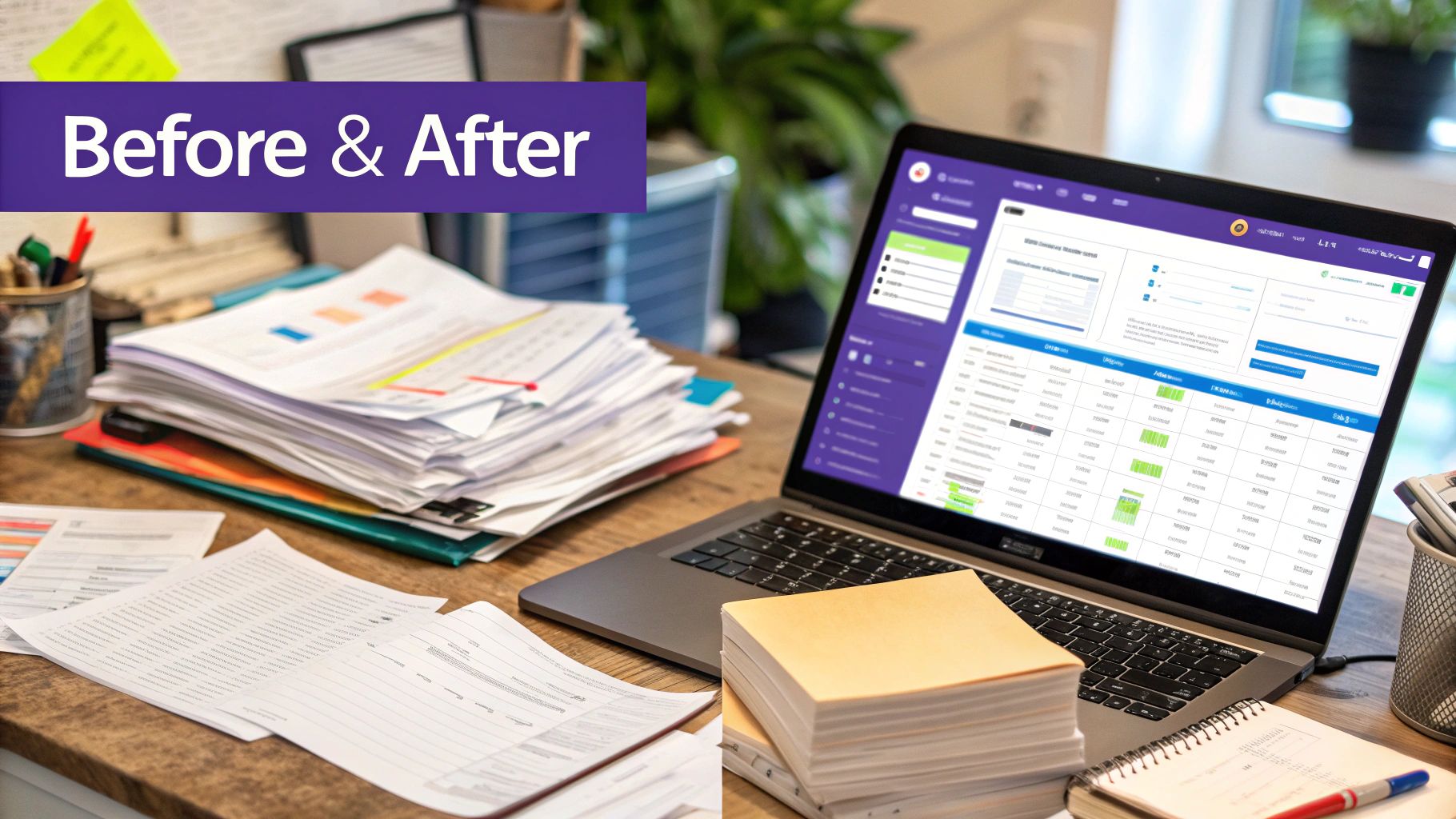
This method deserves its place on this list of top sales email templates due to its effectiveness in appealing to a prospect's aspirations. The BAB framework focuses on the positive transformation your product enables, making the benefits more tangible and concrete. Features like the transformation-focused narrative, the stark contrast between the current and future states, and the presentation of the solution as the bridge to the desired outcome, all contribute to a compelling and persuasive message.
Examples of Successful Implementation:
- Subject: Transform your sales process in 14 days
- Before (Current State): "Right now, your team spends 4+ hours per day on manual data entry, leaving less time for building relationships and closing deals."
- After (Desired Future): "Imagine your reps spending that time on high-value calls instead, boosting revenue by 22% and significantly improving client satisfaction."
- Bridge (Solution): "Our automation platform makes this possible by streamlining data entry, freeing up your sales team to focus on what they do best: selling."
Actionable Tips for Using the BAB Template:
- Quantify the Transformation: Be specific about both the "before" and "after" states, using metrics and data whenever possible to add credibility. Instead of saying "increase efficiency," say "increase efficiency by 15%."
- Speak Their Language: Use the prospect's language and industry-specific terminology when describing their current situation to demonstrate your understanding of their challenges.
- Actionable Bridge: Make the bridge section clear, concise, and actionable. Explain exactly how your product/service facilitates the transformation and provide a clear call to action (e.g., schedule a demo, download a resource).
- Social Proof: Include testimonials or case studies that validate the transformation you're promising, adding further credibility to your claims.
- Emphasize Contrast: Create a strong contrast between the pain of the "before" state and the pleasure of the "after" state to heighten the emotional impact of your message.
Pros and Cons of the BAB Template:
Pros:
- Creates a compelling vision of success.
- Highly effective for aspirational products/services.
- Makes benefits tangible and concrete.
- Often more positive than problem-focused approaches.
Cons:
- Can seem unrealistic if claims are exaggerated.
- Requires a deep understanding of the prospect's current and desired states.
- Sometimes lacks urgency compared to problem-based approaches.
- May be less effective for utility products with modest benefits.
When to Use the BAB Template:
The BAB template is particularly effective when selling products or services that promise significant transformation or improvement. It's ideal for aspirational products, where the focus is on achieving a desired future state. Consider using the BAB framework when targeting decision-makers who are motivated by long-term vision and strategic growth. However, if you're selling a product with more modest benefits or targeting prospects who are primarily driven by immediate problem-solving, a problem-focused approach might be more effective. This template has been popularized by companies like Buffer and email marketing experts like Jimmy Kim, and is featured in resources like Copyblogger. This further demonstrates the effectiveness and wide-spread adoption of the BAB template within sales and marketing circles.
4. The ACCA Template (Awareness-Comprehension-Conviction-Action)
The ACCA (Awareness-Comprehension-Conviction-Action) template stands out among sales email templates for its emphasis on education and building understanding throughout the sales journey. Unlike templates focused on immediate conversions, ACCA excels in complex B2B sales scenarios with longer cycles, where nurturing leads and establishing credibility are paramount. This approach recognizes that informed buyers are more likely to make confident purchasing decisions, particularly when dealing with intricate products or services.
How ACCA Works:
ACCA systematically guides prospects through four key stages:
Awareness: The first step is to grab the prospect's attention by highlighting a relevant pain point, challenge, or untapped opportunity. This could be a pressing industry trend, a regulatory change, or a significant efficiency gap. Eye-opening statistics or thought-provoking questions are effective tools for capturing attention at this stage.
Comprehension: Once awareness is established, the focus shifts to educating the prospect. This stage explains the underlying concepts related to the identified problem or opportunity. The goal is to provide clarity and build a foundational understanding. Using clear language, visuals, or metaphors can simplify complex information and improve comprehension.
Conviction: With a basic understanding in place, the next step is to build conviction. This involves presenting evidence and proof points to demonstrate the value and effectiveness of your solution. Case studies, data-driven testimonials, and quantifiable results are particularly impactful here. The conviction stage bridges the gap between understanding and believing.
Action: The final stage is the call to action. However, unlike more direct sales email templates, the action in ACCA is often a smaller, more logical next step within the longer sales cycle. This could be downloading a white paper, attending a webinar, scheduling a consultation, or reading a relevant blog post. The focus is on progressive commitment, gradually guiding the prospect towards a final purchase decision.
Examples of ACCA in Action:
- Subject: 73% of finance teams miss this critical compliance requirement (Awareness)
- Body: This email opens by highlighting the challenge of staying compliant with evolving regulations. The comprehension section explains the nuances of the new regulations and their potential impact. The conviction section presents case studies of companies that have successfully navigated these changes using your solution. Finally, the action step invites the prospect to download a free compliance checklist.
Pros and Cons of the ACCA Template:
Pros:
- Excellent for complex products/services: Provides the space to adequately explain value propositions.
- Builds credibility through education: Positions you as a trusted advisor.
- Creates informed prospects: Leads to more qualified leads and higher conversion rates.
- Works well in multi-touch campaigns: Allows for progressive engagement and relationship building.
Cons:
- Typically requires longer emails: Demands more time and effort to craft effectively.
- May not drive immediate action: Focuses on long-term nurturing.
- Can be overwhelming if too much information is included: Requires careful balancing of content.
- Requires strong educational content: Necessitates expertise and research.
Tips for Effective ACCA Implementation:
- Awareness: Use compelling statistics and industry insights.
- Comprehension: Simplify complex concepts with visuals and clear language.
- Conviction: Provide specific, data-driven proof points.
- Action: Align the call to action with the sales cycle stage.
- Consider breaking complex ACCA emails into a series: Improves digestibility and engagement.
Why ACCA Deserves Its Place in the List:
The ACCA template offers a distinct approach to sales emails, focusing on education and long-term relationship building. While not suitable for all sales situations, its effectiveness in complex B2B scenarios makes it a valuable tool for any sales or marketing professional dealing with considered purchases. It aligns perfectly with strategies employed by industry leaders like IBM, Salesforce, and HubSpot, further solidifying its relevance and efficacy. By leveraging the power of education and informed decision-making, the ACCA template empowers businesses to connect with prospects on a deeper level, ultimately driving sustainable growth.
5. The 3x3 Research-Based Personalization Template
The 3x3 Research-Based Personalization Template distinguishes itself from generic sales email templates by prioritizing genuine connection and value. It’s a powerful approach for cutting through the noise of crowded inboxes and establishing rapport with prospects, especially in cold outreach. This method involves meticulously researching the prospect across three dimensions: the individual, their company, and their industry, and then weaving these insights into a concise and compelling email. Its focus on personalization contributes significantly to higher open and response rates, justifying the extra effort involved. This makes it a valuable addition to any list of effective sales email templates.
This template works by demonstrating genuine interest and understanding before presenting a solution. Instead of leading with a generic pitch, you begin by acknowledging the prospect's work, company achievements, or relevant industry trends. This personalized approach shows you've taken the time to understand their context, making them more receptive to your message.
Examples of Successful Implementation:
- Subject: [Specific observation about prospect's recent work] - e.g., "Impressive growth at [Company Name] - congrats!"
- Opening with personal observation: "I noticed your LinkedIn post about scaling your marketing team and the challenges you're facing with [specific challenge]."
- Company-specific insight: "Your recent product launch, [product name], appears to be gaining traction in the mid-market segment. The features focusing on [specific feature] seem particularly appealing to this demographic."
- Industry observation: "With the regulatory changes affecting your industry next quarter regarding [specific regulation], adapting your current strategy will be crucial."
- Brief value proposition tied directly to research points: "Given your focus on [specific challenge/goal], our solution can help by [specific benefit related to research]."
Actionable Tips for Readers:
- Deep Dive into Research: Check LinkedIn, the company blog, news mentions, and recent content for personalization points. Learn more about The 3x3 Research-Based Personalization Template for advanced research techniques.
- Highlight Achievements: Reference specific achievements or content the prospect has created to demonstrate your genuine interest.
- Brevity is Key: Limit the email to 3-5 sentences to respect the prospect's time.
- Connect the Dots: Ensure your research points logically connect to your value proposition. The connection should feel natural and not forced.
- A/B Test: Experiment with different types of personalization to see what resonates best with your target audience.
Pros and Cons:
- Pros: Significantly higher open and response rates than generic templates, bypasses typical sales email filters/resistance, creates a perception of thoughtfulness and care, builds relationships from first contact.
- Cons: Time-intensive to create (3-15 minutes per email), not easily scalable for high-volume campaigns, requires research skills and resources, ROI may not justify the effort for lower-value prospects.
When and Why to Use This Approach:
This template is best suited for high-value prospects where building a strong relationship is paramount. While time-consuming, the potential return from securing a key client often outweighs the initial investment. It's ideal for:
- High-stakes sales: Where personalized outreach can significantly influence the decision-making process.
- Building long-term relationships: The 3x3 method sets the foundation for a genuine connection.
- Targeting decision-makers: Executives and senior leaders appreciate the personalized touch and the demonstration of understanding.
This method, popularized by industry leaders like Jason Lemkin (SaaStr founder), Josh Braun (sales trainer and coach), Heather Morgan (Salesfolk founder), and Aaron Ross (Predictable Revenue methodology), offers a powerful alternative to generic outreach. By focusing on genuine engagement and tailored value, the 3x3 Research-Based Personalization Template sets the stage for meaningful and productive sales conversations.
6. The SPIN Template (Situation-Problem-Implication-Need-Payoff)
The SPIN selling methodology, developed by Neil Rackham, provides a powerful framework for guiding prospects through a consultative sales process. This approach translates effectively into a structured email template—the SPIN template—that leverages targeted questions to uncover needs and position your solution as the answer. This sales email template earns its place on this list due to its proven effectiveness in complex B2B sales, particularly where a deeper understanding of the prospect's challenges is crucial. It helps move beyond superficial pitches and fosters genuine engagement, leading to stronger buy-in.
The SPIN acronym represents the four types of questions used in the sequence:
- Situation: These questions establish context and baseline understanding of the prospect’s current situation. Examples include inquiries about their existing processes, tools, or team structure.
- Problem: These questions delve into the challenges and pain points the prospect is facing within their current situation. They aim to uncover specific areas of dissatisfaction or inefficiency.
- Implication: These are crucial questions that explore the consequences of the identified problems. They help the prospect understand the potential negative impact of not addressing these issues, creating a sense of urgency and need.
- Need-Payoff: These questions shift the focus to the positive outcomes and benefits of implementing your solution. They encourage the prospect to visualize the value and envision how your offering can address their needs and alleviate the previously discussed implications.
How it Works in Email:
Unlike a traditional sales email template that focuses on features and benefits, the SPIN template centers around a carefully constructed sequence of questions. Each email typically focuses on one key question within the SPIN framework, allowing for a more digestible and interactive experience for the prospect. Providing valuable insights and context between questions can further enhance engagement and demonstrate your expertise.
Example Implementation:
Let's say you're selling marketing automation software. Here’s how a SPIN email sequence might unfold:
- Email 1 (Situation): Subject: Question about your marketing automation strategy. Body: "Hi [Prospect Name], I noticed [Company Name] is doing some great work in [Industry]. I'm curious, how is your team currently handling lead nurturing?"
- Email 2 (Problem): Subject: Following up on lead nurturing. Body: "Thanks for your response. Building on that, have you experienced challenges with lead qualification efficiency within your current process?"
- Email 3 (Implication): Subject: The impact of lead qualification. Body: "Inefficient lead qualification can significantly impact growth. How has this affected your sales cycle length and conversion rates?"
- Email 4 (Need-Payoff): Subject: Streamlining your lead nurturing. Body: "If you could automate this process and improve qualification accuracy by 40%, how would that impact your quarterly targets and free up your team to focus on closing deals?"
Pros:
- Engages prospect actively: The question-based approach fosters a dialogue, making the prospect an active participant rather than a passive recipient.
- Self-discovery: Guiding prospects to identify their own needs creates stronger buy-in and conviction.
- Highly effective for complex sales: The SPIN method excels in situations where the solution needs to be tailored to specific, complex challenges.
Cons:
- Requires skill: Poorly executed, the questioning can feel like an interrogation.
- Lengthier process: It may require multiple email exchanges.
- Thoughtful question formulation: Generic questions will yield generic (and unhelpful) answers.
Tips for Effective Implementation:
- Thorough Research: Tailor your questions to the specific prospect and their industry for a personalized experience.
- One Question Per Email: Avoid overwhelming the prospect with multiple questions in a single email.
- Open-Ended Questions: Encourage thoughtful responses, not simple yes/no answers.
- Patience: Allow the process to unfold naturally and avoid rushing to the solution.
- Provide Value: Offer insights and demonstrate your expertise between questions.
The SPIN sales email template, popularized by Neil Rackham and adopted by major corporations, provides a structured and effective approach to complex B2B sales. While requiring careful execution, its ability to engage prospects, facilitate self-discovery, and create a stronger need for your solution makes it a valuable tool in any sales professional’s arsenal.
7. The Challenger Template: Disrupting the Status Quo in Sales Emails
The Challenger Template, inspired by the Challenger Sales methodology, stands out among sales email templates for its disruptive and thought-provoking approach. Instead of focusing on the prospect's perceived needs, this template aims to educate and challenge their existing assumptions, ultimately positioning you as a thought leader and trusted advisor. This approach can be particularly effective for complex B2B sales, especially when dealing with senior executives and decision-makers who are constantly bombarded with traditional sales pitches. This template earns its place on this list because it offers a refreshing alternative to the usual sales email fare, focusing on adding value upfront.
This method operates on the principle of offering valuable commercial insight. It highlights potential areas where the prospect could be losing or leaving money on the table – areas they likely haven't considered – and then seamlessly connects these insights to your unique capabilities. It's about reframing their perspective and demonstrating your expertise, rather than simply pushing your product.
Features of the Challenger Template:
- Insight-driven: Focuses on providing valuable information rather than addressing stated needs.
- Challenges Status Quo: Proactively challenges the prospect's current thinking and operations.
- Educational with Commercial Focus: Educates the prospect while simultaneously highlighting the financial implications.
- Positions Seller as Thought Leader: Establishes credibility and expertise within the industry.
Pros:
- Differentiation: Sets you apart from competitors using generic sales approaches.
- Value Creation: Provides valuable insights even if the prospect doesn't immediately purchase.
- Effective for Complex B2B Sales: Well-suited for scenarios requiring in-depth understanding and considered decision-making.
- Resonates with Senior Executives: Appeals to decision-makers seeking innovative solutions and data-driven approaches.
Cons:
- Potential Resistance: Can be perceived as threatening if the challenge is not presented carefully.
- Requires Deep Industry Knowledge: Demands substantial expertise to be truly convincing.
- Difficult to Execute: More challenging than basic templates, requiring careful research and tailoring.
- Not Ideal for Relationship-Focused Buyers: May not work well with buyers prioritizing existing relationships over disruptive insights.
Examples:
- Subject: The hidden cost in your supply chain strategy
- Opening with compelling insight: "78% of manufacturing leaders are optimizing the wrong metrics in their supply chain..."
- Challenging conventional thinking: "While most companies focus on unit costs, our research shows delivery reliability actually drives 3x more profitability..."
- Presenting unique solution approach: "By reframing the KPIs to prioritize..."
- Offering specific next steps to explore the insight further: "Let's schedule a brief call to discuss how these findings could impact your specific supply chain." Learn more about The Challenger Template
Actionable Tips for Implementing the Challenger Template:
- Lead with Data: Start with compelling data or insights that contradict common industry assumptions.
- Focus on Business Outcomes: Emphasize the potential financial benefits and improvements to the prospect's bottom line.
- Reframe the Challenge: Offer a new perspective on how the prospect should approach their current challenges.
- Quantify the Opportunity Cost: Use specific metrics to demonstrate the potential losses associated with maintaining the status quo.
- Offer Educational Content: Instead of immediately pushing product demos, provide valuable resources like white papers or research reports as next steps.
When to Use the Challenger Template:
This sales email template is ideal when targeting sophisticated buyers in complex B2B environments, particularly when dealing with high-value deals and long sales cycles. It’s effective when you have deep industry knowledge and can confidently challenge conventional wisdom. However, it’s important to gauge the prospect's openness to new ideas and tailor the approach accordingly.
The Challenger Template, popularized by Matthew Dixon and Brent Adamson (authors of The Challenger Sale) and backed by CEB/Gartner research, has been successfully adopted by companies like Grainger, Cisco, and Microsoft. By leveraging this approach, you can elevate your sales emails from generic pitches to valuable conversations, ultimately driving more meaningful engagement and boosting your conversion rates.
Sales Email Template Comparison Overview
| Template | 🔄 Implementation Complexity | 💡 Key Advantages | 📊 Expected Outcomes | ⚡ Resource Requirements | ⭐ Ideal Use Cases |
|---|---|---|---|---|---|
| The AIDA Framework | Medium – clear stepwise process | Proven, logical flow; strong conversion focus | Effective lead progression; high conversions | Moderate – content customization & research | Broad industries; straightforward sales |
| The PAS Template (Problem-Agitate-Solve) | Low to Medium – focused narrative | Emotionally engaging; urgency creation | High engagement for problem-aware prospects | Low – needs pain point insights | Problem-aware audiences; short & long emails |
| The BAB Template (Before-After-Bridge) | Medium – storytelling with contrast | Creates compelling transformation vision | Inspires aspiration; tangible benefits | Moderate – requires solid before-after insight | Aspirational products; transformational offers |
| The ACCA Template | High – educational, multi-step | Builds credibility; educates and informs | Creates informed, trustful prospects | High – strong content, longer sequences | Complex B2B sales; long sales cycles |
| 3x3 Research-Based Personalization | High – research-intensive | Highly personalized; builds genuine relationships | Higher open and response rates | High – deep, tailored research per prospect | High-value outreach; relationship-building |
| The SPIN Template | High – question-heavy, iterative | Engages prospect; drives self-discovery | Strong buy-in; uncovers needs | High – requires thoughtful question design | Complex B2B; consultative selling |
| The Challenger Template | High – insight-driven & challenging | Differentiates; positions seller as thought leader | Thought-provoking, uncovering hidden opportunities | High – deep industry knowledge & data needed | Complex B2B; senior execs; strategic sales |
Elevate Your Sales Outreach with quiky.email and These Powerful Templates
This article explored seven impactful sales email templates designed to transform your outreach strategy: AIDA, PAS, BAB, ACCA, the 3x3 Research-Based Personalization Template, SPIN, and the Challenger Template. Each offers a unique approach to connecting with prospects, addressing their needs, and ultimately driving conversions. We’ve seen how structuring your emails with these frameworks allows for clear communication, strategic persuasion, and increased engagement. Understanding the core principles behind each—whether it's grabbing attention with AIDA, highlighting the pain points with PAS, or leveraging research with the 3x3 template—is key to crafting compelling sales email templates.
The most important takeaway is the power of combining proven structures with personalized messaging. Generic, mass-sent emails are a thing of the past. Tailoring your sales email templates to specific target audiences and individual prospects is non-negotiable for success in today’s competitive landscape. This is where quiky.email becomes invaluable. Its AI-powered capabilities allow you to personalize email drafts at scale, ensuring each message resonates deeply with the recipient and effectively moves them through the sales funnel.
By mastering these sales email templates and utilizing quiky.email's advanced features, you can significantly enhance your outreach effectiveness. Don't just send emails; create targeted conversations that build genuine connections and drive tangible results. Move beyond simple outreach and transform your sales process by implementing these strategies today. Start with quiky.email and experience the difference that data-driven, personalized sales emails can make in achieving your business goals. The future of sales is personalized, and the power to shape that future is in your hands.
Key Takeaways
Essential learnings that you should remember from this article
- Understand the core principles behind each sales email template.
- Learn how to structure emails for maximum engagement and conversion.
- Identify common pitfalls to avoid when crafting sales emails.
Practical Tips
Actionable tips you can apply immediately to improve your email performance
Personalize Your Emails
Use the recipient's name and relevant details to make your emails feel tailored and engaging.
Focus on Benefits Over Features
Highlight how your product or service solves the prospect's problems rather than just listing features.
Test and Optimize
Experiment with different templates and approaches to see what resonates best with your audience.
Common Mistakes to Avoid
Pitfalls and misconceptions to avoid when writing persuasive emails
- Using generic templates without personalization.
- Focusing too much on features instead of benefits.
- Neglecting to follow up after initial outreach.
Tools to Apply These Concepts
Put what you've learned into practice with these specialized tools
Related Content
Continue exploring with these related articles and tools