
Follow Up Email After No Response: Boost Your Reply Rate
Unlock the secrets to successful follow-up emails! Discover the psychology behind non-responses, learn how to craft compelling subject lines, and explore effective templates that can transform your outreach efforts.
Why Your Follow-Up Email After No Response Matters
In the busy world of business, emails can easily get overlooked. Your carefully crafted message might be buried under a pile of other correspondence. This is why a follow-up email after no response is so important. It gives you a second chance to connect and keep the conversation going.
The Psychology of Non-Responses
A non-response doesn't necessarily mean disinterest. Perhaps the recipient is busy, overwhelmed, or simply forgot to reply. A follow-up email acts as a gentle reminder, bringing your message back to their attention.
Persistence Pays Off
Persistence is key in professional communication. Many people give up after just one email, losing potential opportunities. Multiple touchpoints can greatly increase your chances of a response. It shows you're serious, dedicated, and truly interested in connecting. Whether it's closing a deal or scheduling a meeting, following up makes it more likely you'll achieve your goal.
For example, imagine you're trying to connect with a potential client. One email might not be enough, but a well-timed follow-up could be the difference between getting a meeting and not. The importance of follow-up emails in sales is highlighted by a 2024 Belkins study which analyzed 7.5 million client emails. The first follow-up email increased the response rate by an average of 49%. This statistic underscores the power of persistence. For more detailed statistics, you can learn more about follow up email statistics.
Let's take a look at how response rates can improve with each follow-up email. The table below provides a clearer picture of this trend.
Response Rate Comparison: Initial Email vs. Follow-ups This table shows how response rates increase with each subsequent follow-up email in a sequence.
| Email Sequence Position | Average Response Rate | Improvement Over Initial Email |
|---|---|---|
| Initial Email | 10% (Assumed baseline) | - |
| 1st Follow-up | 14.9% (Belkins data) | +49% |
| 2nd Follow-up | 17.4% (Illustrative, based on potential further improvement) | +74% |
| 3rd Follow-up | 18.5% (Illustrative, showing diminishing returns) | +85% |
As you can see, while subsequent follow-ups can continue to improve response rates, the impact tends to diminish with each additional email. It's about finding the right balance between persistence and respecting the recipient's time.
Timing Is Everything
While persistence is important, avoid overwhelming someone with emails. This can be counterproductive and harm your reputation. The key is to strategically time your follow-ups, giving enough time between messages while staying top-of-mind.
Industry and Context Matter
The best timing for a follow-up email depends on the industry, the communication context, and your relationship with the recipient. A follow-up after a sales call might be sent within 24 hours, while a follow-up to a networking email might be sent a few days later. A job application follow-up may require a different approach altogether.
By understanding the nuances of follow-up emails, you can improve your communication strategy, increase your response rates, and achieve greater success. Remember, a non-response isn't a closed door. It's a chance to follow up strategically and keep the conversation going.
Crafting Subject Lines That Get Your Follow-Ups Opened
The first step to getting your follow-up email read after no initial response is the subject line. It's the gatekeeper of your message. A weak subject line can send your email straight to the trash. A compelling one, however, can re-engage a prospect and prompt them to finally open your email.
The Psychology of a Second Glance
Think about your own inbox. What makes you open an email, especially one you might have initially ignored? It often comes down to curiosity, relevance, and urgency. Your follow-up subject lines need to tap into these psychological triggers. A bland subject line like "Following Up" simply won't work.
Balancing Urgency and Value
While creating a sense of urgency can be effective, avoid sounding desperate or demanding. Phrases like "ASAP" or "Urgent" can trigger spam filters and create a negative impression. Instead, subtly hint at time-sensitive information or an opportunity. For example, "Checking In: [Original Topic] + Quick Question" sparks interest without being overly aggressive.
Personalization and Context
Personalizing your subject line can significantly improve your open rates. Including the recipient's name or referencing a previous conversation makes your email feel more relevant and less generic. For instance, instead of “Following up on the proposal,” try "Following up on [Project Name] Proposal, [Recipient Name]". Learn more in this article about How to master effective subject lines.
Examples of Effective Subject Lines
Here are a few examples of subject lines that effectively re-engage recipients:
- Checking In: [Original Topic] + Quick Question
- Re: [Original Subject Line] - Quick Update
- [Recipient Name], Still Interested in [Topic]?
- An Idea for [Recipient's Problem/Goal]
- Quick Question About [Original Topic]
Avoiding Common Pitfalls
Just as there are effective strategies, there are also common pitfalls to avoid:
- Generic Subject Lines: "Following Up" or "Checking In" are too vague.
- Deceptive Subject Lines: Misleading subject lines will damage your credibility.
- Overly Long Subject Lines: Keep it concise. Aim for around 50 characters or less.
- Spam Trigger Words: Avoid words like "Free," "Guarantee," or "Limited Time Offer". These can trigger spam filters.
A/B Testing for Optimized Subject Lines
One highly effective technique for optimizing your subject lines is A/B testing. This involves sending two versions of your email with different subject lines to a small test group. Analyze the open rates for each version to identify the more effective subject line. Use the winning version for your broader outreach. This data-driven approach ensures you are continuously improving your subject lines for maximum impact. This means crafting a captivating subject line is essential for re-engaging prospects and getting a response.
Building Your Perfect Follow Up Email Sequence
Following up after no response is essential for successful communication. It's not just about sending another email; it's about crafting a strategic sequence. This sequence should gently encourage a response without being overly persistent. This involves understanding the ideal number of emails, the time between them, and how your message should change with each attempt.
The Science of Follow-Up Sequencing
The number of follow-up emails you send can drastically affect your response rate. Some people give up after one or two tries, but research shows that persistence can be worthwhile. Cold email campaigns, for instance, often see better results with strategic follow-ups. A Woodpecker study found that campaigns with 4-7 follow-up emails have a 27% reply rate. This is three times higher than campaigns with only 1-3 emails! Find more detailed statistics here. Sending at least three follow-ups can increase responses by up to 28%. This highlights the importance of a well-planned follow-up strategy.
Timing Your Follow-Ups
When you send your follow-ups is just as important as how many you send. Too soon, and you seem pushy. Too late, and your message gets lost. The infographic below shows a good timeline for follow-up emails. The first follow-up is on Day 3, the second on Day 7, and a final reminder on Day 14.
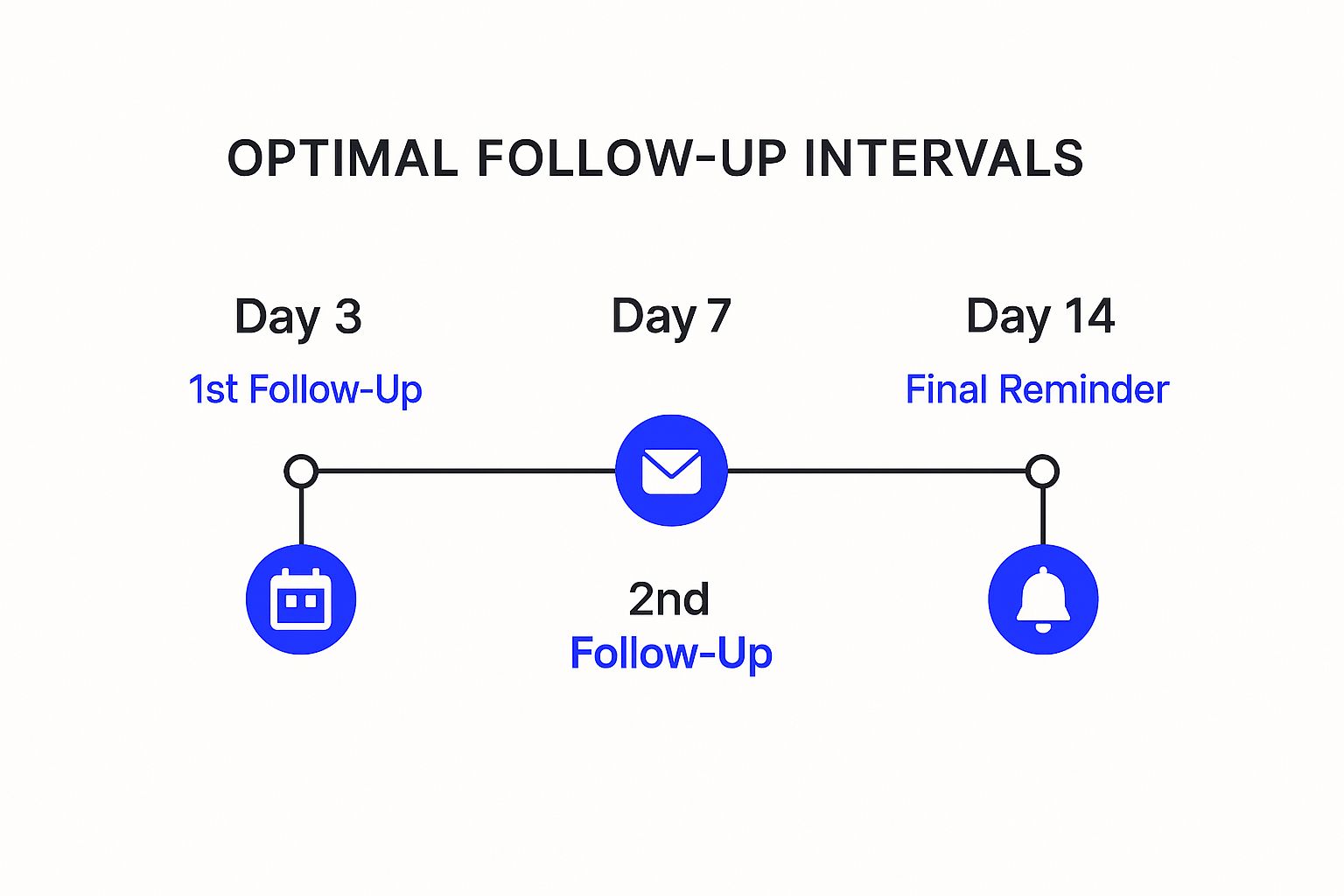
This timeline offers a balanced approach, giving enough time between contacts while keeping the conversation going. It provides a structure for consistent engagement without overwhelming the recipient.
To further understand effective follow-up strategies, check out this helpful resource: How to master your follow-up emails.
Evolving Your Message
Each follow-up email should add something new, building on the last one. Offer new information or a different angle, instead of repeating your first request. Imagine it as a conversation. Your first email is the opening line. Each follow-up adds details and invites engagement.
The following table outlines a recommended timeline and approach for an optimal follow-up email sequence:
Optimal Follow-Up Email Sequence Timeline A comprehensive guide to timing your follow-up emails for maximum effectiveness
| Follow-up Number | Days After Previous Email | Key Focus | Recommended Approach |
|---|---|---|---|
| 1 | 3 | Reiterate Value | Briefly restate the initial message's value proposition and offer additional context or information. |
| 2 | 4 (7 days total) | Provide Additional Information | Share a case study, testimonial, or relevant resource to further highlight the benefits. |
| 3 | 7 (14 days total) | Create a Sense of Urgency | Introduce a limited-time offer, exclusive resource, or deadline to encourage prompt action. |
This table provides a framework for structuring your follow-up sequence, ensuring each email has a distinct purpose and contributes to a cohesive communication strategy. Remember to tailor your approach to the specific context and relationship with the recipient.
Adding Value and Creating Closure
Including valuable content in your follow-ups is key. This might be helpful resources, interesting articles, or relevant tips related to the recipient's industry. This shows real interest and positions you as helpful. Even if you get no reply after several attempts, write a final follow-up that provides closure. This could be a simple thank you for their time, or an offer to connect later. This leaves a positive impression and keeps the door open for future communication. By following these guidelines, you can create a follow-up email sequence that maximizes your chances of a response.
10 High-Converting Follow-Up Email Templates That Work
Silence after sending an email can be frustrating. A well-crafted follow-up, however, can turn that silence into a productive conversation. This section explores ten high-converting email templates for various situations, from sales and job applications to networking and meeting requests.
Understanding the Power of Follow-Up Emails
Follow-up emails are essential for breaking through the clutter of a busy inbox. They remind the recipient of your initial message and encourage a response. Persistence is key. 80% of sales require five follow-ups before closing, highlighting the importance of continued effort. Furthermore, follow-up emails dramatically improve customer engagement, offering a 50% boost for companies that use them. Find more detailed statistics here.
Template 1: The "Checking In" Email
This template provides a gentle nudge a few days after your first email.
- Subject: Checking In: [Original Subject]
- Body: Hi [Name], I hope this email finds you well. I wanted to follow up on my previous email concerning [topic]. Do you have any questions, or would you like to discuss this in more detail?
Template 2: The "Value-Add" Email
Share additional resources to capture the recipient's attention.
- Subject: [Original Subject] - Helpful Resource
- Body: Hi [Name], I'm following up on my last email. I thought this resource might be useful: [link]. It offers helpful information on [topic] and could be relevant to your work on [project/area].
Template 3: The "Question" Email
Ask a direct question to prompt a reply.
- Subject: Quick Question about [Original Subject]
- Body: Hi [Name], A quick question regarding my earlier email about [topic]. Is this something you handle, or could you direct me to the right contact?
Template 4: The "Alternative Solution" Email
If your initial proposal wasn't suitable, suggest an alternative.
- Subject: Re: [Original Subject] - Another Option
- Body: Hi [Name], I'm following up on my previous message. If [original offer] isn't a good fit right now, I wanted to share another possibility: [alternative offer].
Template 5: The "Final Follow-Up" Email
Politely conclude the email chain if no response is received.
- Subject: Re: [Original Subject] - Closing the Loop
- Body: Hi [Name], I understand you're busy. This is my final follow-up regarding [topic]. Please feel free to reach out if you're still interested.
Template 6: The Job Application Follow-Up
Express your continued interest in the position.
- Subject: Following Up on [Job Title] Application
- Body: Dear [Hiring Manager Name], I'm writing to follow up on my application for the [Job Title] role. I remain very interested and would appreciate learning more.
Template 7: The Post-Interview Follow-Up
Reiterate your qualifications and thank the interviewer.
- Subject: Thank You - [Your Name] - [Job Title] Interview
- Body: Dear [Interviewer Name], Thank you for speaking with me about the [Job Title] position. I enjoyed learning more about [Company] and the role itself.
Template 8: The Meeting Request Follow-Up
Restate the meeting's purpose and offer alternative times.
- Subject: Re: Meeting Request - [Topic]
- Body: Hi [Name], I'm following up on my meeting invitation. Are you available on [date] at [time], or would [alternative time] be better?
Template 9: The Networking Follow-Up
Maintain the connection after an initial introduction.
- Subject: Connecting After [Event/Meeting]
- Body: Hi [Name], It was great to meet you at [event/meeting]. I particularly enjoyed our discussion about [topic].
Template 10: The Sales Follow-Up
Nurture the lead and address any objections.
- Subject: Addressing your concerns about [Product/Service]
- Body: Hi [Name], Following up on our discussion about [Product/Service]. I wanted to address your concerns regarding [objection].
These templates are a great foundation for impactful follow-up emails. Remember to personalize each message and include specific details. You can also enhance and personalize these templates using quiky.email to ensure they resonate with your audience and lead to higher conversion rates. Combining email with phone calls can increase conversions by 30%, emphasizing a diverse follow-up approach. By using these templates and strategies, you can effectively re-engage prospects and achieve your communication objectives.
Adding Genuine Value In Every Follow-Up Email
The line between persistence and annoyance in follow-up emails is thin. The key differentiator? Value. Every follow-up email after no response should offer something new and relevant to the recipient. Think of it like nurturing a plant; you wouldn't just keep watering it without adding nutrients. Similarly, each email should contribute to the conversation's growth.
Understanding The Different Forms Of Value
Value isn't always a discount or a freebie. It can take many forms, depending on your audience and context:
Industry Insights: Share a recent article, report, or statistic related to their field. This positions you as knowledgeable and helpful.
Relevant Resources: Offer a helpful tool, template, or guide that addresses a specific challenge they face. This demonstrates your genuine interest in their success.
Social Proof: Showcase testimonials or case studies that demonstrate how others have benefited from your product or service. This provides credibility and builds trust.
Time-Sensitive Opportunities: Highlight an upcoming webinar, limited-time offer, or exclusive event. This creates a sense of urgency and encourages prompt action.
For example, if you're following up with a marketing manager, sharing a new study on social media engagement or a free marketing automation template would be more valuable than simply restating your initial sales pitch.
Aligning Value With Recipient Needs
Generic value-adds won’t make a difference. You need to tailor your offering to the recipient's specific challenges and objectives. This requires research and a deep understanding of their business or role. You might be interested in: How to master composing effective emails.
Imagine you’re contacting a small business owner struggling with website traffic. Offering a free SEO audit or a guide to local SEO would be far more impactful than sending a general marketing eBook. This personalized approach shows you’ve taken the time to understand their needs, making your follow-up far more compelling.
Presenting Value Concisely And Effectively
Even valuable information can be ignored if presented poorly. Keep your follow-up emails short and focused. Clearly state the value proposition upfront and link it directly to the recipient’s needs.
For instance, instead of just attaching a whitepaper, explain how it addresses a specific challenge they mentioned in a previous conversation or on their website. This direct connection makes the value clear and increases the likelihood of engagement.
Using Value As A Bridge To Your Call To Action
The ultimate goal of your follow-up email after no response is to move the conversation forward. Use the value you offer as a natural bridge to your call to action.
For example, after sharing a relevant case study, you might suggest a brief call to discuss how similar results could be achieved for their business. This approach positions your call to action not as a sales push, but as a logical next step in providing further assistance. By consistently offering genuine value in each follow-up, you transform from a persistent salesperson to a trusted advisor. This approach builds rapport, increases response rates, and ultimately leads to more productive conversations.
Knowing When to Stop Your Follow Up Email Sequence
Persistence is key when following up after receiving no response. But knowing when to stop is just as important. Going beyond a certain point can hurt your reputation and waste valuable time. This section explores how to find that stopping point and gracefully conclude your outreach.
Recognizing the Limits of Persistence
Multiple follow-ups can significantly boost your response rate. However, there's a point of diminishing returns. Overwhelming someone with emails after they haven't responded to several attempts can backfire. This can result in being flagged as spam, or worse, creating a negative impression of your brand.
Factors Influencing Your Stop Point
Several factors influence when to stop following up:
- Outreach Purpose: A sales pitch might require more follow-ups than a networking email.
- Relationship Context: Following up with an established contact is different from pursuing a cold lead. Existing relationships typically allow for more attempts.
- Response Patterns: A complete lack of engagement (no opens, clicks, or replies) across several emails suggests it's time to move on.
For instance, a time-sensitive proposal might require a shorter, more intensive sequence. Nurturing a long-term lead, on the other hand, might involve a more spaced-out approach with fewer emails.
Crafting a Graceful Exit Strategy
Even when ending a follow-up sequence, maintain professionalism. Leave the door open for future communication. A well-crafted final message can accomplish this:
- Acknowledge the Lack of Response: Briefly mention you haven’t heard back.
- Reiterate Your Value Proposition: Remind them of the key benefit you offer.
- Express Understanding: Acknowledge their busy schedule. Respect their implied decision not to engage currently.
- Offer Future Connection: Suggest connecting later, or invite them to reach out if their situation changes.
Here’s an example: "I understand you're busy, and I haven't heard back about my previous emails regarding [topic]. I still believe [your offering] could significantly benefit your [area/goal]. I'll hold off on further contact for now, but please feel free to reach out if you'd like to discuss this further down the road."
Maintaining Prospect Records for Future Engagement
Even after stopping your follow-up emails, don’t discard the contact information. Keep organized records of your outreach. Categorize prospects based on their engagement levels. This allows you to re-engage them later, perhaps with a different approach or a new offer. You can use tools like quiky.email to organize and personalize your efforts more efficiently. By strategically managing your prospect data, you ensure no potentially valuable connection is lost. Knowing when to stop following up demonstrates respect for the recipient's time. It allows you to focus your energy on more promising leads, ultimately improving your overall outreach effectiveness.
Automating Your Follow-Up Email Process Without Losing the Human Touch
Following up after no response is critical for improving reply rates. However, manually managing these follow-ups can be incredibly time-consuming, especially as your outreach expands. This is where email automation becomes invaluable. It helps you scale your efforts while still retaining a personalized feel, ensuring your messages resonate with each recipient.
Why Automate Your Follow-Up Emails?
Automating your follow-up emails offers several key benefits:
- Increased Efficiency: Free up valuable time and resources by automating repetitive tasks, allowing you to focus on other important aspects of your business.
- Improved Consistency: Ensure consistent communication with every lead, maximizing your opportunities for a response and nurturing potential customers.
- Enhanced Personalization: Use personalization tokens to customize each message, making them more relevant and engaging for individual recipients.
- Data-Driven Optimization: Track key performance indicators (KPIs) of your automated sequences and make data-informed adjustments to improve their effectiveness over time.
Choosing the Right Email Automation Platform
Many platforms specialize in follow-up email automation, each offering a range of features and integrations. Consider these factors when selecting a platform:
- Ease of Use: An intuitive interface will make creating and managing automated sequences straightforward, even for those without technical expertise.
- Personalization Options: The platform should allow for dynamic content insertion using personalization tokens, enabling you to tailor messages effectively.
- Integration Capabilities: Seamless integration with your existing CRM, email marketing platform, and other business tools is crucial for streamlined workflows.
- Cost-Effectiveness: Choose a platform that aligns with your budget and provides a pricing model that can scale as your business grows.
Implementing Triggered Sequences and Conditional Logic
Effective automation goes beyond simply scheduling emails. Triggered sequences send specific follow-ups based on recipient actions, such as opening an email or clicking a link. For example, if a recipient opens your initial follow-up but doesn't click your call to action, trigger a second follow-up offering additional resources or addressing potential objections.
Conditional logic further refines this process by tailoring sequences based on recipient attributes or behaviors. You might send different follow-up messages to leads in different industries or segments, providing a more targeted approach.
Maintaining a Human Touch in Automated Emails
While automation streamlines your process, retaining a genuine, human touch is essential. Here’s how:
- Personalize Beyond the Name: Go beyond simply using the recipient's name. Incorporate personalized tokens to reference their specific interests, pain points, or previous interactions.
- Write Like a Human: Craft compelling emails that sound natural and conversational, avoiding generic or robotic language. Focus on building rapport.
- Use A/B Testing: Experiment with different email variations to identify what resonates most effectively with your audience and optimize your messaging.
- Monitor for Replies: Pause or stop automated sequences once a recipient replies to prevent sending unnecessary or irrelevant messages.
Best Practices for Testing and Measuring Performance
Regularly compare your automated sequences against manual efforts. Analyze key metrics such as open rates, click-through rates, and conversion rates. Identify what resonates with your audience and continuously refine your approach based on their engagement. This data-driven strategy ensures your automation stays effective and aligned with your overall goals.
Streamline your email outreach and improve your reply rates without sacrificing personalization. Try quiky.email, a free AI-powered tool designed to help professionals write impactful emails, including follow-up sequences, replies, and compelling subject lines. Start automating your follow-ups today with quiky.email.
Key Takeaways
Essential learnings that you should remember from this article
- Follow-up emails significantly increase response rates, with studies showing a 49% increase after the first follow-up.
- Timing and personalization are crucial; tailor your follow-up strategy based on the recipient's context and industry.
- Each follow-up should add value, whether through insights, resources, or addressing specific needs.
Practical Tips
Actionable tips you can apply immediately to improve your email performance
Craft Compelling Subject Lines
Use curiosity and relevance to create subject lines that grab attention, avoiding generic phrases.
Implement A/B Testing
Test different email versions to determine which subject lines and content resonate best with your audience.
Automate Wisely
Utilize email automation tools to streamline follow-ups while maintaining a personal touch.
Common Mistakes to Avoid
Pitfalls and misconceptions to avoid when writing persuasive emails
- Sending generic follow-ups that lack personalization.
- Overwhelming recipients with too many emails in a short period.
- Failing to provide value in each follow-up email.
Tools to Apply These Concepts
Put what you've learned into practice with these specialized tools
Related Content
Continue exploring with these related articles and tools