
7 Cold Email Templates for Sales to Close Deals in 2025
Transform your cold email strategy with seven proven templates that leverage psychological principles for increased engagement and conversions. Learn how to craft personalized messages that resonate with your audience and drive results.
Stop Sending Generic Emails: Master Outreach with These Templates
Tired of low open rates? Generic cold emails don't work. This article provides seven proven cold email templates for sales to boost your outreach. Learn how to craft compelling messages that grab attention and drive conversions using the AIDA, PAS, Referral, BAB, PPP, Short & Sweet, and Mutual Connection LinkedIn templates. We'll provide examples and best practices for each, helping you transform cold emails into hot leads. Stop hitting send and start seeing results with these effective cold email templates for sales.
1. The AIDA Cold Email Template
The AIDA cold email template is a powerful tool for sales outreach, leveraging a time-tested marketing framework to craft compelling messages. AIDA, which stands for Attention, Interest, Desire, and Action, guides prospects through a psychological journey designed to increase engagement and conversion rates. This template provides a structured approach to cold emailing, moving from an attention-grabbing opener to a clear call to action, systematically building the prospect's interest and desire along the way. This method deserves its place on this list due to its established effectiveness, adaptability across industries, and focus on delivering value to the prospect.
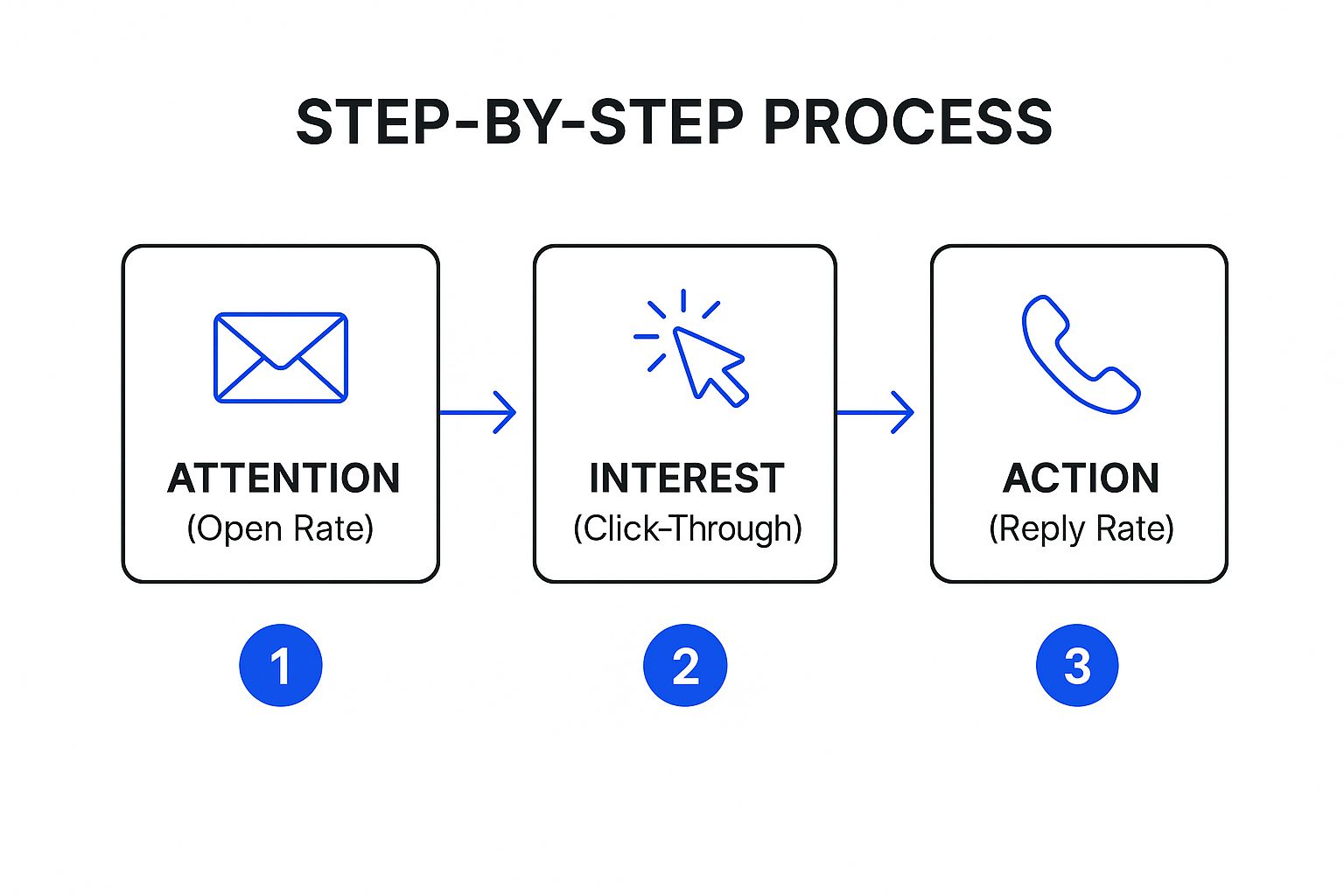
The infographic above visualizes the AIDA process as a funnel, highlighting the sequential nature of each stage. It emphasizes the importance of transitioning smoothly between grabbing the prospect's attention and ultimately driving them towards the desired action. Notice how the funnel narrows as it progresses, illustrating the ideal conversion path from initial contact to a sales opportunity.
The AIDA model provides a clear framework for structuring your cold email. The process starts with grabbing the Attention of the prospect, perhaps with a personalized insight related to their business. Next, pique their Interest by highlighting a pain point relevant to their industry and subtly positioning your product/service as a potential solution. Then, create Desire by showcasing specific results achieved for similar clients, including quantifiable benefits. Finally, conclude with a clear Action, a simple and low-commitment request like a brief introductory call. This progressive engagement structure ensures the email remains focused and guides the prospect naturally towards conversion.
Features of the AIDA Cold Email Template:
- Four-stage psychological framework: Provides a proven structure for persuasive communication.
- Progressive engagement structure: Maintains prospect interest and guides them through the sales funnel.
- Value-focused narrative: Emphasizes benefits and outcomes rather than just features.
- Clear call-to-action component: Prompts the prospect to take the next step.
Pros:
- Psychologically sound sequence: Taps into established principles of persuasion.
- Adaptable to various industries: Can be tailored to suit different products, services, and target audiences.
- Focuses on benefits rather than features: Speaks directly to the prospect's needs and desires.
- Guides the prospect naturally toward conversion: Facilitates a smooth transition from initial contact to sales opportunity.
Cons:
- Can become formulaic if not personalized: Requires thorough research and customization for optimal results.
- May require longer email length: Accommodating all four stages can lead to longer emails.
- Effectiveness depends on quality of research: Generic or inaccurate information can damage credibility.
- Can feel manipulative if poorly executed: Authenticity and genuine value proposition are crucial.
Example:
Subject: [Personalized insight about prospect's business]
Hi [Name],
[Attention] I noticed [specific observation about their business] and thought of how [your company] helped [similar company] with this challenge.
[Interest] Many [industry] businesses struggle with [specific pain point]. Our [product/service] specifically addresses this by [brief value proposition].
[Desire] Clients like [reference customer] have seen [specific result] after implementing our solution, saving them [quantifiable benefit].
[Action] Would you be open to a 15-minute call this Thursday at 10 AM to discuss how we might achieve similar results for [prospect's company]?
Regards, [Your name]
Tips for Using AIDA Cold Email Templates for Sales:
- Research the prospect thoroughly before writing.
- Customize each section with relevant insights.
- Use specific metrics and results when building desire.
- Keep the action simple and low-commitment.
- A/B test different attention-grabbers to optimize performance.
Popularized By: Elmer Wheeler (original AIDA concept), David Ogilvy (advertising pioneer), HubSpot (modern adaptation for email), Neil Patel (digital marketing expert)
Learn more about The AIDA Cold Email Template
When and why should you use this approach? The AIDA cold email template is ideal for reaching out to new prospects and introducing your product or service. It's particularly effective when you have a clear understanding of your target audience's pain points and can demonstrate how your offering provides a solution. This approach is also valuable when you want to establish a structured and persuasive narrative in your cold emails, maximizing the chances of engagement and conversion.
2. The Problem-Agitate-Solve (PAS) Template
The Problem-Agitate-Solve (PAS) template is a highly effective framework for crafting persuasive cold email templates for sales. It operates on a fundamental principle of human psychology: addressing pain points. By first identifying a problem your prospect faces, then amplifying the negative implications of that problem (agitation), and finally presenting your product or service as the ideal solution, you create a compelling narrative that drives action. This approach leverages emotional engagement to establish the value proposition of your offering and generate genuine interest. It's a conversion-driven structure, typically shorter than other templates, making it suitable for busy professionals.

The PAS framework focuses on problem identification, building upon it with emotional engagement through pain point amplification, and culminating in a solution-oriented conclusion. This structure allows you to position your product or service as a direct remedy to specific challenges the prospect experiences. This approach deserves its place on this list due to its potent psychological underpinnings and effectiveness in capturing attention and driving conversions.
Features:
- Problem identification focus: The template starts by clearly identifying a pain point relevant to the prospect.
- Emotional engagement through pain point amplification: It then agitates this problem by highlighting its negative consequences.
- Solution-oriented conclusion: The final stage presents your offering as the much-needed solution.
- Conversion-driven structure: The entire framework is designed to persuade the prospect to take the desired action.
Pros:
- Highly persuasive psychological approach: Taps into the prospect's inherent desire to avoid pain and seek solutions.
- Creates emotional connection through pain recognition: Demonstrates empathy and understanding of the prospect's challenges.
- Positions your offering as a direct solution to specific challenges: Clearly articulates the value proposition of your product/service.
- Generally shorter than other templates: Respects the prospect's time and increases the chance of being read.
- Works well for prospects aware of their problems: Directly addresses existing concerns, leading to quicker engagement.
Cons:
- Can seem negative or alarming if overplayed: Requires careful balancing of problem agitation and solution presentation.
- Requires accurate identification of prospect's problems: Ineffective if the problem isn't genuinely relevant.
- Not ideal for relationship-building as a first touch: The focus on pain points can be off-putting if not handled delicately.
- May not work for prospects unaware of their problems: Requires a different approach for prospects who haven't yet identified their challenges.
Example:
Subject: Eliminating High Customer Churn at [Prospect's Company]
Hi [Name],
[Problem] I've noticed many SaaS companies like yours struggle with high customer churn, often resulting in lost revenue and stunted growth.
[Agitate] This typically leads to increased customer acquisition costs as you constantly need to replace lost customers, which can ultimately impact your profitability. In today's competitive SaaS landscape, this puts companies at a significant disadvantage.
[Solve] We've developed [customer retention software] specifically to address this. [Company name] has helped [number] similar businesses reduce churn by [specific metric], resulting in a [specific percentage] increase in customer lifetime value.
Could I share a brief case study showing how we helped a company similar to yours overcome this challenge?
Best, [Your name]
Tips for Successful Implementation:
- Research specific pain points relevant to the prospect: Generic problems won't resonate; tailor your message to their individual needs.
- Use industry-specific language to show expertise: Demonstrate your understanding of their business and its unique challenges.
- Quantify the problem's impact whenever possible: Using data and metrics strengthens your argument and adds credibility.
- Present a clear, concrete solution with evidence: Back up your claims with case studies, testimonials, or data.
- Always follow up with additional value: Continue the conversation by offering valuable resources or insights related to their problem.
Popularized By: Dan Kennedy (direct response marketing expert), Gary Halbert (copywriting legend), Salesforce (enterprise implementation), Close.io (B2B sales application).
3. The Referral Cold Email Template
The Referral Cold Email Template distinguishes itself from other cold email templates for sales by leveraging pre-existing relationships to warm up the introduction. Instead of reaching out cold, this template uses a mutual connection, industry peer, or relevant referral source as a bridge to the prospect. This immediately establishes credibility and fosters a sense of trust and familiarity, significantly boosting open and response rates compared to traditional cold outreach. This method effectively bypasses the initial suspicion that often accompanies unsolicited emails, opening the door for a more receptive audience.

This template is built upon several key features: the social proof element inherent in referencing a known contact, a trust-building introduction, connection-based relevance, a warm introduction approach, and the establishment of personal context. These elements combine to create a much more inviting first impression. For sales teams looking to improve their cold email performance, especially in niche markets or when targeting high-value prospects, the referral approach offers a distinct advantage. Learn more about The Referral Cold Email Template
Example:
Subject: [Mutual Connection's Name] suggested I reach out
Hi [Prospect Name],
[Mutual Connection] and I were discussing [relevant industry challenge] last week, and they mentioned your work at [Company] might benefit from our approach to [value proposition].
[Their Company] has been using our [product/service] to [achieve specific result], and [Mutual Connection] thought our solution for [specific pain point] might be relevant to your current initiatives.
Would you be open to a brief conversation to explore if what's working for [Their Company] might also benefit your team at [Prospect's Company]?
Best regards, [Your Name]
Pros:
- Higher open and response rates: The referral immediately captures attention and piques interest.
- Establishes immediate credibility: Leveraging a shared connection bypasses the need to build trust from scratch.
- Creates a natural conversation starter: The referral provides a readily available topic and context for discussion.
- Reduces resistance to the sales pitch: The warm introduction softens the ground for a more receptive audience.
- Leverages existing social capital: Capitalizes on existing network connections to expand reach and influence.
Cons:
- Requires actual connections or network: This template is ineffective without genuine shared connections.
- Can backfire if the reference isn't actually strong: A weak or irrelevant referral can damage credibility.
- Limited scalability compared to other templates: Building and maintaining a network for referrals takes time and effort.
- Potential to damage relationships if overused or misused: Excessive or inappropriate use of referrals can strain relationships.
Tips for Effective Implementation:
- Always get permission: Obtain consent from your reference before using their name.
- Be specific: Clearly explain why the referral suggested the connection.
- Personalize beyond the referral: Conduct thorough research on the prospect to demonstrate genuine interest.
- Don't oversell the connection: Present the referral honestly and avoid exaggerating its strength.
- Follow up: Keep both the prospect and the referrer informed about the outcome of the outreach.
The Referral Cold Email Template earns its place on this list due to its effectiveness in fostering trust and increasing engagement. Popularized by platforms like LinkedIn Sales Navigator and experts like Adam Grant, Trey Rosen, and Keith Ferrazzi, the strategic use of referrals has become a recognized best practice in relationship-building and sales. By strategically leveraging existing connections, businesses can enhance their cold outreach efforts and cultivate more meaningful relationships with potential clients.
4. The Before-After-Bridge (BAB) Template
The Before-After-Bridge (BAB) template is a persuasive framework for cold email templates for sales, leveraging a contrast-based narrative structure to highlight the transformation your product or service can offer. It works by painting a clear picture of the prospect's current world ("Before"), juxtaposing it with a vision of an improved future state ("After"), and then building a "Bridge" explaining how your solution facilitates that transition. This approach focuses on outcomes and tangible benefits rather than simply listing features, making it particularly effective for complex or innovative solutions. Its effectiveness lies in its ability to create a compelling vision of improvement and clearly demonstrate the value proposition. This is why it deserves its place in this list of top cold email templates for sales.
How it Works:
The BAB template strategically uses contrast to capture attention and create desire. By starting with the "Before" scenario, you acknowledge the prospect's current challenges and pain points, making them feel understood. The "After" section then presents a desirable alternative, painting a picture of a better future with your solution. Finally, the "Bridge" connects the two, positioning your product or service as the vehicle for achieving that desired transformation. This method resonates with both aware and unaware prospects as it focuses on the value they receive, not just the product's features.
Example:
Subject: How [Company Name] is transforming lead generation for businesses like yours
Hi [Prospect Name],
[Before] Right now, companies like yours typically spend countless hours manually sourcing leads, often resulting in low conversion rates and wasted resources. You're likely sifting through outdated databases, struggling with ineffective outreach strategies, and seeing minimal return on your investment.
[After] Imagine instead: a consistent stream of qualified leads delivered directly to your sales team, increased conversion rates by up to 30%, and a significant boost in sales pipeline – all while drastically reducing the time spent on manual lead generation.
[Bridge] At [Your Company], we've helped organizations like [reference customer – e.g., similar company in their industry] make this exact transition through our AI-powered lead generation platform that specifically identifies and qualifies ideal prospects based on your target demographics. They've seen a 25% increase in qualified leads within just two months.
Would a 15-minute call next week make sense to explore if we could achieve similar results for [Prospect's Company]?
Regards,
[Your Name]
Features and Benefits:
- Contrast-based narrative: Creates a compelling story of transformation.
- Visualization of improved future state: Helps prospects envision the benefits.
- Transformation focus: Emphasizes outcomes rather than features.
- Solution as transition mechanism: Positions your product/service as the key to improvement.
- Outcome-oriented messaging: Clearly demonstrates the value proposition.
Pros:
- Highlights tangible benefits and outcomes.
- Creates a compelling vision of improvement.
- Easy to understand value proposition.
- Works well for both aware and unaware prospects.
- Effective for complex or innovative solutions.
Cons:
- Can seem hypothetical without solid evidence.
- Requires deep understanding of prospect's current state.
- May need more detailed follow-up.
- Risk of over-promising outcomes.
Tips for Effective Implementation:
- Research: Thoroughly research the prospect's current situation and challenges.
- Specificity: Use specific metrics and quantifiable outcomes in the "After" section.
- Evidence: Provide evidence or case studies to support the claimed transformation. This could be statistics, testimonials, or case study summaries.
- Concise Bridge: Keep the "Bridge" section concise and clearly explain how your solution delivers the promised benefits.
- Follow Up: Be prepared to follow up with additional proof points if there's no initial response.
Popularized By:
SaaS companies like Slack and Dropbox, along with marketing influencers like Ray Edwards, have effectively used variations of the BAB framework. Email marketing platforms like ConvertKit and social media solutions like Buffer also employ similar strategies in their outreach. While they may not explicitly call it the BAB template, the underlying principle of contrasting the before and after scenarios remains a powerful persuasive tool.
5. The Praise-Picture-Push (PPP) Template
The Praise-Picture-Push (PPP) template offers a nuanced approach to cold emailing for sales, prioritizing relationship building over aggressive selling. This method distinguishes itself from generic templates by focusing on genuine recognition of the prospect's achievements before introducing the product or service. This strategy positions you as a potential collaborator rather than a mere vendor, increasing the likelihood of a positive response and fostering long-term engagement. It's particularly effective for high-value prospects where building trust and rapport are crucial. This template deserves its place on the list of effective cold email templates for sales because of its ability to bypass common sales objections and initiate meaningful conversations.
How it Works:
The PPP template follows a three-step structure:
- Praise: Begin by genuinely praising a specific achievement, piece of content, or company milestone. This demonstrates research and genuine interest, immediately setting a positive tone.
- Picture: After the praise, paint a picture of how your solution complements or enhances the prospect's existing success. Connect their accomplishments and priorities to the benefits of your product or service. This helps the prospect visualize the potential value proposition.
- Push: Finally, propose a next step, such as a brief conversation or a product demo. This "push" should be gentle and collaborative, framing the interaction as an opportunity for mutual benefit.
Example:
Subject: Impressed by your [specific achievement or content]
Hi [Prospect Name],
[Praise] I recently came across your article on [publication] about [topic] and was particularly impressed by your insights on [specific aspect]. Your approach to [relevant area] is truly innovative.
[Picture] Given your focus on [business priority they've mentioned, e.g., scaling customer acquisition], I thought you might be interested in how [your product/service, e.g., our AI-powered marketing platform] has been helping companies like [reference customer, e.g., Company X] enhance their [relevant function, e.g., lead generation] by [quantifiable result, e.g., 20%] while maintaining the innovative approach you're known for.
[Push] I'd welcome the opportunity to share some specific ideas about how we might support your continued growth in [area of focus, e.g., customer acquisition]. Would you be open to a brief conversation next week?
Regards, [Your Name]
Features and Benefits:
- Positive Opening with Genuine Recognition: Starts the conversation on a positive note, making the prospect more receptive.
- Collaborative Positioning: Presents you as a partner invested in their success, not just a salesperson.
- Soft-Sell Approach: Avoids aggressive sales tactics, focusing on building relationships.
- Relationship-Building Focus: Prioritizes long-term engagement over immediate conversions.
- Complementary rather than Corrective Framing: Focuses on enhancing existing strengths rather than highlighting weaknesses.
Pros:
- Creates a positive first impression.
- Demonstrates research and genuine interest.
- Less likely to trigger defense mechanisms.
- Establishes a respectful peer relationship.
- Works well for high-value prospects.
Cons:
- Requires meaningful research to find praiseworthy elements.
- May not create enough urgency.
- Can seem insincere if the praise is generic.
- Typically lower immediate conversion rate (but higher quality conversations).
Tips for Implementation:
- Research Thoroughly: Find something genuinely praiseworthy through social media, recent news, or company websites.
- Connect the Dots: Directly link your praise to your solution's relevance.
- Be Specific and Authentic: Generic praise can backfire. Focus on specific details and use their own language.
- Focus on Their Priorities: Use the prospect's own language and priorities when painting the picture of how your solution can help them.
- Keep the Push Gentle: Frame the next step as a collaborative opportunity.
Influences and Popularization:
The PPP template draws inspiration from established principles of influence and sales engagement, including the work of Dale Carnegie, Josh Braun, Gong.io, and Shane Snow. These individuals and organizations have emphasized the importance of building rapport, understanding customer needs, and focusing on value creation in the sales process.
6. The Short and Sweet Template
In the competitive landscape of sales, capturing a prospect's attention is paramount. The Short and Sweet template offers a powerful approach to cold emailing, specifically designed for cutting through the noise and landing in the inbox of busy decision-makers. This method prioritizes brevity and clarity, recognizing the value of time in today's fast-paced business world. It earns its place on this list of effective cold email templates for sales because it offers a high likelihood of being read completely, especially by executive-level prospects who are constantly bombarded with information.
This template typically restricts emails to under 100 words, often encompassing just 3-5 sentences. While concise, it doesn't sacrifice personalization. In fact, the short and sweet approach necessitates a high personalization-to-word ratio, ensuring that every word contributes to demonstrating research and establishing relevance. This template focuses on delivering a single, clear value proposition, minimizing formatting distractions, and concluding with a direct question as a call to action. This streamlined approach optimizes readability, particularly on mobile devices, which are increasingly the primary mode of communication for many professionals.
Features of the Short and Sweet Template:
- Extreme brevity: Typically 3-5 sentences total.
- Single clear value proposition: No fluff, just the core benefit.
- Minimal formatting: Easy to read and digest.
- Direct question as call to action: Encourages engagement.
- High personalization-to-word ratio: Demonstrates genuine interest.
Pros:
- Respects prospect's time.
- Higher likelihood of being read completely.
- Forces clarity in value proposition.
- Works well on mobile devices.
- Easier to test and iterate on.
- Higher response rates with executive-level prospects.
Cons:
- Limited space for building relationships.
- May not provide enough information for complex offerings.
- Requires exceptional precision in writing.
- Less room for traditional persuasive elements.
Example:
Subject: Quick question about [specific challenge] at [Company]
Hi [Name],
Your recent [initiative/post/achievement] caught my attention, particularly your focus on [specific element relevant to your solution].
[Company Name] helps [target industry] businesses [core value proposition in 10 words or less]. [Relevant competitor/peer] saw [specific result] after implementing our approach.
Would you be interested in seeing how similar results might be possible for [Prospect's Company]?
[Your Name]
Tips for Implementation:
- Lead with the most relevant personalization possible.
- Cut ruthlessly – every word must earn its place.
- Use one specific result or case study rather than multiple.
- Test multiple subject lines with this format.
- Follow up with slightly more detail if no response. Learn more about The Short and Sweet Template after sending your initial email to plan your follow-up strategy.
This approach has been popularized by figures like Guy Kawasaki (known for his 3-sentence email rule) and Tim Ferriss (an advocate for efficiency), and championed by platforms like Drift (conversational marketing) and Mailchimp (email marketing research). It’s a testament to the power of concise and targeted communication in the realm of sales. This method is particularly well-suited for business professionals, sales and marketing teams, and even freelancers and entrepreneurs looking for a highly effective cold email strategy. By focusing on the core value proposition and respecting the prospect's time, the short and sweet template can dramatically improve your cold email open and response rates.
7. The Mutual Connection LinkedIn Template
This template leverages the networking power of LinkedIn for sales outreach, transforming a cold email approach into a warmer introduction. It capitalizes on shared connections, group memberships, or shared experiences to establish immediate relevance and mitigate the "stranger danger" often associated with unsolicited contact. This approach positions your outreach within a pre-existing professional context, increasing the likelihood of engagement and fostering trust. This is particularly valuable for cold email templates for sales as it warms up the lead before a formal email is even sent.
How it Works:
The Mutual Connection LinkedIn template relies on identifying a common link between you and your prospect on LinkedIn. This could be a shared connection, membership in the same professional group, following the same company, or even having attended the same university. This shared context is then used as the basis for your connection request, instantly establishing a point of familiarity and reducing the perception of being a complete stranger.
Examples of Successful Implementation:
- Subject: [Shared Connection Name] suggested I connect
Hi [Name],
[Shared Connection Name] mentioned you might be interested in [Your Company]'s work in [specific area]. Given your experience in [specific detail from their profile or content], I thought it would be beneficial to connect.
At [Your Company], we help [target professionals] achieve [brief value proposition]. I'd be happy to share more about how we've helped similar professionals in your field.
Would you be open to connecting?
Regards, [Your Name]
- Subject: Connecting from [Mutual Group Name]
Hi [Name],
We're both members of the [Mutual Group Name] group on LinkedIn. I've been following your insights on [specific topic] with great interest, especially your recent post on [specific post title].
At [Your Company], we're focused on providing [brief value proposition] to [target professionals]. I believe there could be some valuable synergies between our work, particularly in the area of [specific area].
Would you like to connect and explore potential collaborations?
Best, [Your Name]
Actionable Tips:
- Customize: Personalize each connection request by referencing the specific shared background. Generic templates are easily spotted and often ignored.
- Research: Review the prospect's recent activity before reaching out. This allows you to tailor your message to their current interests and needs.
- Engage: Interact with their content (like or comment on a post) before or immediately after sending the connection request. This demonstrates genuine interest and increases visibility.
- Brevity: Keep connection requests concise and to the point to comply with LinkedIn's character limits and maintain the prospect's attention.
- Follow Up: After connecting, send a personalized message with valuable insights or resources related to their industry or interests. Don't immediately pitch your product or service.
When and Why to Use This Approach:
This template is ideal for:
- Targeting professionals on LinkedIn whom you have a pre-existing connection with, however tenuous.
- Building rapport before sending a more formal sales email.
- Establishing credibility and trust by leveraging shared professional contexts.
- Reaching decision-makers who are often inundated with traditional cold emails.
Pros:
- Higher acceptance and response rates compared to cold emailing.
- Provides automatic social context and credibility.
- Allows prospects to view your full professional profile for further validation.
- Creates multiple engagement options (message, connection request, content interaction).
Cons:
- Character limits on initial connection requests can restrict messaging.
- Less formal than email, which may not be suitable for all industries.
- Requires a complete and professional LinkedIn profile.
- Limited ability to include attachments or richly formatted content.
- Less private than email communication.
Popularized By: Experts like Brynne Tillman, Richard van der Blom, and Ryan Deiss, as well as LinkedIn Sales Navigator's platform features, have highlighted the effectiveness of this approach.
This template deserves its place on this list because it offers a powerful way to bridge the gap between cold outreach and warm introductions, significantly increasing the effectiveness of your cold email templates for sales by leveraging the inherent networking capabilities of LinkedIn. By strategically using shared connections and professional contexts, this template increases engagement rates and lays the foundation for building valuable business relationships.
7 Cold Email Templates Comparison
| Template | Implementation Complexity 🔄 | Resource Requirements 💡 | Expected Outcomes 📊 | Ideal Use Cases 💡 | Key Advantages ⭐ / ⚡ |
|---|---|---|---|---|---|
| The AIDA Cold Email Template | Medium - follows a 4-stage structure | Moderate - requires research and personalization | High - guides prospect toward conversion | Multi-industry, benefit-focused campaigns | ⭐ Psychologically sound; ⭐ Adaptable; ⚡ Clear call-to-action |
| The Problem-Agitate-Solve (PAS) | Low to Medium - 3-step focused framework | Moderate - needs accurate problem identification | High - creates urgency and emotional impact | Prospects aware of their problems | ⭐ Highly persuasive; ⚡ Shorter emails; ⭐ Direct solution focus |
| The Referral Cold Email Template | Medium - requires genuine network connections | High - needs actual referrals/granted permissions | Very High - boosts open and response rates | Warm introductions using existing connections | ⭐ Trust-building; ⭐ Higher response rates; ⚡ Natural conversation |
| The Before-After-Bridge (BAB) | Medium to High - contrast and transition narrative | Moderate - in-depth understanding of prospect | High - focuses on transformation and results | Complex or innovative solutions | ⭐ Compelling vision; ⭐ Outcome-oriented; ⚡ Easy to understand |
| The Praise-Picture-Push (PPP) | Medium - requires authentic praise and soft push | High - requires meaningful research | Moderate - builds relationships, quality leads | Relationship-building, high-value prospects | ⭐ Positive tone; ⭐ Builds rapport; ⚡ Collaborative approach |
| The Short and Sweet Template | Low - very brief and concise | Low - minimal personalization and formatting | Moderate to High - quick reads and responses | Busy executives; mobile-first readers | ⚡ Extremely concise; ⚡ Respects time; ⭐ Higher read rates |
| The Mutual Connection LinkedIn Template | Medium - platform-specific constraints | Moderate - requires professional LinkedIn profile | High - social context increases engagement | LinkedIn outreach leveraging mutual connections | ⭐ Higher acceptance; ⭐ Multiple engagement options; ⚡ Credibility |
Elevate Your Sales Outreach with quiky.email
This article explored seven powerful cold email templates for sales, ranging from the classic AIDA formula to the targeted Mutual Connection LinkedIn approach. We examined how each template leverages specific psychological principles to engage prospects and drive conversions. Key takeaways include understanding the importance of personalization, crafting compelling subject lines, highlighting value propositions effectively, and maintaining a concise and professional tone throughout your communication. Mastering these concepts is crucial for maximizing your outreach effectiveness and generating a higher return on your sales efforts. Ultimately, optimizing your cold email strategy translates directly into increased lead generation, stronger customer relationships, and boosted revenue growth.
Cold emailing remains a vital component of successful sales strategies. By implementing the templates and best practices discussed, you can dramatically improve your chances of cutting through the noise and connecting with potential clients. Don't let generic, impersonal emails hold your sales team back. quiky.email makes applying these cold email templates for sales easy and impactful. Streamline your workflow and craft personalized, high-converting emails with quiky.email’s AI-powered platform. Visit quiky.email today and experience the future of email outreach for free.
Key Takeaways
Essential learnings that you should remember from this article
- Understand the psychological frameworks behind effective cold emails.
- Learn to personalize outreach for better engagement and response rates.
- Identify common pitfalls in cold emailing and how to avoid them.
Practical Tips
Actionable tips you can apply immediately to improve your email performance
Research Your Prospects
Thoroughly research your prospects to tailor your emails and address their specific pain points.
Use Clear Subject Lines
Craft catchy and relevant subject lines to increase open rates.
Follow Up Strategically
Implement a follow-up strategy to re-engage prospects who did not respond initially.
Common Mistakes to Avoid
Pitfalls and misconceptions to avoid when writing persuasive emails
- Sending generic emails without personalization.
- Failing to follow up after the initial outreach.
- Not clearly stating the call to action.
Tools to Apply These Concepts
Put what you've learned into practice with these specialized tools
Related Content
Continue exploring with these related articles and tools