
Top Sample Meeting Invitation Email Examples for 2025
Unlock the secrets to effective communication with our guide on crafting meeting invitations. Learn to use 7 essential templates that cater to formal, casual, client, and virtual meetings, ensuring clarity and boosting attendance.
A clear, concise meeting invitation email is crucial for securing attendance and setting expectations. This listicle provides seven sample meeting invitation email templates to cover various professional scenarios, from formal business meetings and client interactions to casual team check-ins and executive briefings.
Ready to optimize your meeting invites? Let's dive in.
1. Formal Business Meeting Invitation Template
The Formal Business Meeting Invitation Template is the gold standard for communication in corporate settings where professionalism and clarity are paramount.
This approach prioritizes a structured format adhering to traditional business etiquette, ensuring all necessary information is conveyed efficiently and effectively. It relies on clear subject lines, formal salutations, detailed meeting logistics, and professional closings to create a serious and respectful tone.
This template is particularly well-suited for high-stakes meetings, discussions with executives or clients, and situations demanding meticulous attention to detail. Its structured nature leaves no room for ambiguity, ensuring all participants are well-informed and prepared.
 This template distinguishes itself through several key features: a precise subject line explicitly stating the meeting's purpose and date, a formal salutation using appropriate titles (e.g., Mr., Ms., Dr.), a structured body outlining the agenda, date, time, location, and duration of the meeting, a clear RSVP request with a specified deadline, and a professional closing including contact information.
These elements work in concert to create a comprehensive and unambiguous sample meeting invitation email.
Example:
Subject: Quarterly Budget Review Meeting - March 15, 2023
Dear Mr. Thompson,
I would like to invite you to our upcoming Quarterly Budget Review Meeting scheduled for Wednesday, March 15, 2023, from 2:00 PM to 3:30 PM EST in Conference Room A.
Agenda:
Q1 Performance Review
Budget Allocation for Q2
Department Funding Requests
Please confirm your attendance by March 10th. If you have any items you would like to add to the agenda, please let me know by March 8th.
Sincerely,
Jane Smith
Financial Director
ABC Corporation
(555) 123-4567
Pros:
Projects professionalism and attention to detail: This approach conveys a sense of seriousness and respect for the attendees' time.
Leaves no ambiguity about meeting logistics: All critical information is clearly presented, minimizing potential confusion.
Appropriate for high-stakes meetings: Ideal for meetings with executives, clients, or other important stakeholders.
Sets a serious tone for important discussions: The formality of the template establishes the importance of the meeting's subject matter.
Cons:
May come across as too rigid for creative industries: A less formal approach might be more suitable for some organizations.
Can feel impersonal compared to casual templates: The structured nature may not foster a sense of camaraderie.
Takes more time to craft properly: Requires careful attention to detail and adherence to specific formatting conventions.
Tips for Successful Implementation:
Use specific meeting titles rather than generic ones (e.g., "Q1 Budget Review" instead of "Meeting").
Include all logistical information (date, time, location, duration) in bullet points for easy scanning.
Send the invitation at least 5-7 business days in advance, especially for important meetings.
Attach any pre-reading materials directly to the email for easy access.
When to Use This Approach:
This template is ideal for formal business settings, particularly when interacting with senior management, clients, external partners, or in situations where a professional image is crucial. It is highly effective for board meetings, budget reviews, legal discussions, and other high-stakes meetings demanding meticulous planning and clear communication.
This formal approach earns its place on this list due to its effectiveness in conveying professionalism and ensuring clarity. Its structured nature and adherence to business etiquette make it a reliable choice for conveying important information and setting the appropriate tone for crucial discussions. While it may not be suitable for all contexts, its value in formal business communication is undeniable. This method is popularized by Fortune 500 corporations, financial institutions, legal firms, and government agencies, highlighting its effectiveness in professional environments.
2. Casual Team Meeting Invitation Template
The Casual Team Meeting Invitation Template offers a friendly and conversational approach to internal team communication. Designed for modern workplaces that prioritize team spirit and engagement, this sample meeting invitation email strikes a balance between professionalism and a warmer tone, making it ideal for regular check-ins, brainstorming sessions, or project updates.
This approach leverages a more relaxed style to boost attendance and encourage open communication within the team.
 This template distinguishes itself through several key features: a friendly subject line (often incorporating emojis), a casual greeting addressing the team collectively, conversational language clearly outlining the meeting's purpose, a concise agenda with time expectations, and a collaborative closing that encourages active participation. This creates a sample meeting invitation email that feels more like a conversation starter than a formal directive.
Example:
Subject: Team Huddle: Project Phoenix Update 🚀 - Thursday @ 11am
Hey team!
Let's sync up this Thursday at 11am in the Innovation Room (or join via Zoom: [link]) for a quick 30-minute catch-up on Project Phoenix.
We'll cover:
What we've accomplished this sprint
Blockers anyone's facing
Next priorities
Come prepared to share your wins and challenges. Coffee and donuts will be provided for in-person attendees!
Can't make it? Let me know and I'll share the notes afterward.
Cheers,
Alex
Pros:
Builds team rapport and encourages attendance: The informal tone fosters a sense of camaraderie and makes team members more likely to attend and actively participate.
Less intimidating than formal templates: This approach can be particularly beneficial for teams where open communication and idea sharing are crucial.
Adaptable to various team cultures: The template can be easily tweaked to align with specific team dynamics and communication styles.
Quick to write and personalize: It saves time while still allowing for a personalized touch.
Cons:
May be too casual for meetings with senior leadership or external stakeholders: Formal meetings require a different approach.
Could be perceived as unprofessional in traditional industries: Consider your company culture and audience before using this style.
May not convey the urgency or importance of critical meetings: For high-stakes meetings, a more formal tone might be necessary.
Tips for Effective Implementation:
Use team-specific language and inside jokes that resonate with your team's culture.
Keep it brief – aim for no more than 150 words to respect everyone's time.
Include a hook or incentive for attendance (like food, a fun activity, or an interesting discussion topic).
Send reminders closer to the meeting date to minimize no-shows.
When to Use This Approach:
This casual approach is best suited for regular team meetings, brainstorming sessions, project updates, or informal check-ins where the goal is to foster collaboration and open communication. It's particularly popular in tech startups, creative agencies, modern collaborative workplaces, and remote-first companies like Buffer and Gitlab.
However, it’s crucial to analyze your specific context and audience to ensure this casual sample meeting invitation email aligns with your company culture and the meeting’s objectives.
This template earns its place on this list by providing a valuable alternative to overly formal communication, contributing to a more positive and productive team environment.
3. Client Meeting Request Template
The Client Meeting Request Template is a strategic approach to crafting sample meeting invitation emails, specifically designed for engaging clients or prospects. It prioritizes a balance between professional communication and personalized outreach, clearly articulating the value proposition while simplifying the response process for busy recipients. This method is particularly effective for sales, consulting, or service-based businesses seeking to initiate productive client interactions and convert leads.
 This template operates on the principle of demonstrating value upfront. It achieves this through a subject line that highlights mutual benefit, a personalized opening referencing past interactions or specific research conducted on the client’s business, and a clear articulation of how the meeting will address the client’s needs.
Offering multiple specific time slots and incorporating a streamlined response mechanism, such as a calendar link or simple reply options, further optimizes the process.
Example:
Subject: Ideas to improve your conversion rates - 20 min discussion?
Hi Sarah,
I noticed your recent website redesign for Acme Corp looks fantastic. Based on our work with similar B2B companies in your industry, I believe we could help increase your conversion rates by 15-20% with some targeted optimization strategies.
Would you be open to a brief 20-minute call to discuss these specific opportunities for Acme? I could share two case studies that are particularly relevant to your situation.
How does your calendar look for any of these times?
Tuesday, Oct 10 at 10am or 2pm EST
Wednesday, Oct 11 at 11am EST
Thursday, Oct 12 at 1pm EST
Alternatively, you can schedule directly on my calendar here: [Calendar Link]
Looking forward to speaking with you,
Jamie Rodriguez
Senior Consultant, XYZ Optimization
[email protected] | 555-987-6543
Pros:
Increased response rates: The client-focused approach resonates with busy individuals, increasing the likelihood of a positive response to the meeting invitation email.
Demonstrates professionalism: Personalized details and specific time slots demonstrate respect for the client’s time and show preparation.
Provides conversation starters: By highlighting client-specific needs and potential solutions, the template sets the stage for a productive meeting.
Flexible usage: Adaptable for both new prospects and existing clients, ensuring consistent and professional communication.
Cons:
Requires research: Effective personalization requires pre-meeting research, which can be time-consuming.
Maintenance: Time slots need frequent updates to remain current and avoid scheduling conflicts.
Potential for misinterpretation: If not carefully balanced, the direct approach can be perceived as overly sales-focused.
Tips for Effective Implementation:
Thorough Research: Invest time in researching the client and their business to personalize the sample meeting invitation email effectively. Mention specific challenges or achievements to demonstrate genuine interest.
Specific Time Slots: Offer 3-4 concrete time options rather than open-ended availability to simplify scheduling.
Calendar Integration: Include a calendar scheduling link to minimize back-and-forth emails and streamline the process.
Strategic Follow-Up: If there’s no response after 3-4 business days, send a concise and polite follow-up email.
This template earns its place on this list due to its targeted approach and demonstrable effectiveness in securing client meetings. Its structured format, combined with personalized details and a clear value proposition, significantly enhances the chances of a positive response.
Popularized by sales methodologies like SPIN Selling and Challenger Sale, and adopted by leading consulting firms and SaaS companies, this template provides a robust framework for initiating valuable client interactions. Using this format for your sample meeting invitation email will greatly increase your chances of getting a response and securing that crucial first meeting.
4. Virtual Meeting Invitation Template
A Virtual Meeting Invitation Template is a specialized email template designed to streamline the process of inviting and preparing participants for online meetings. It addresses the unique needs of virtual gatherings by focusing on clear communication of technical details, establishing virtual etiquette guidelines, and ensuring participants have the necessary information for seamless joining and effective participation.
This approach recognizes the potential for technical difficulties, scheduling confusion, and communication breakdowns that can occur in remote settings. A well-crafted virtual meeting invitation mitigates these challenges, leading to more productive and engaging online meetings.
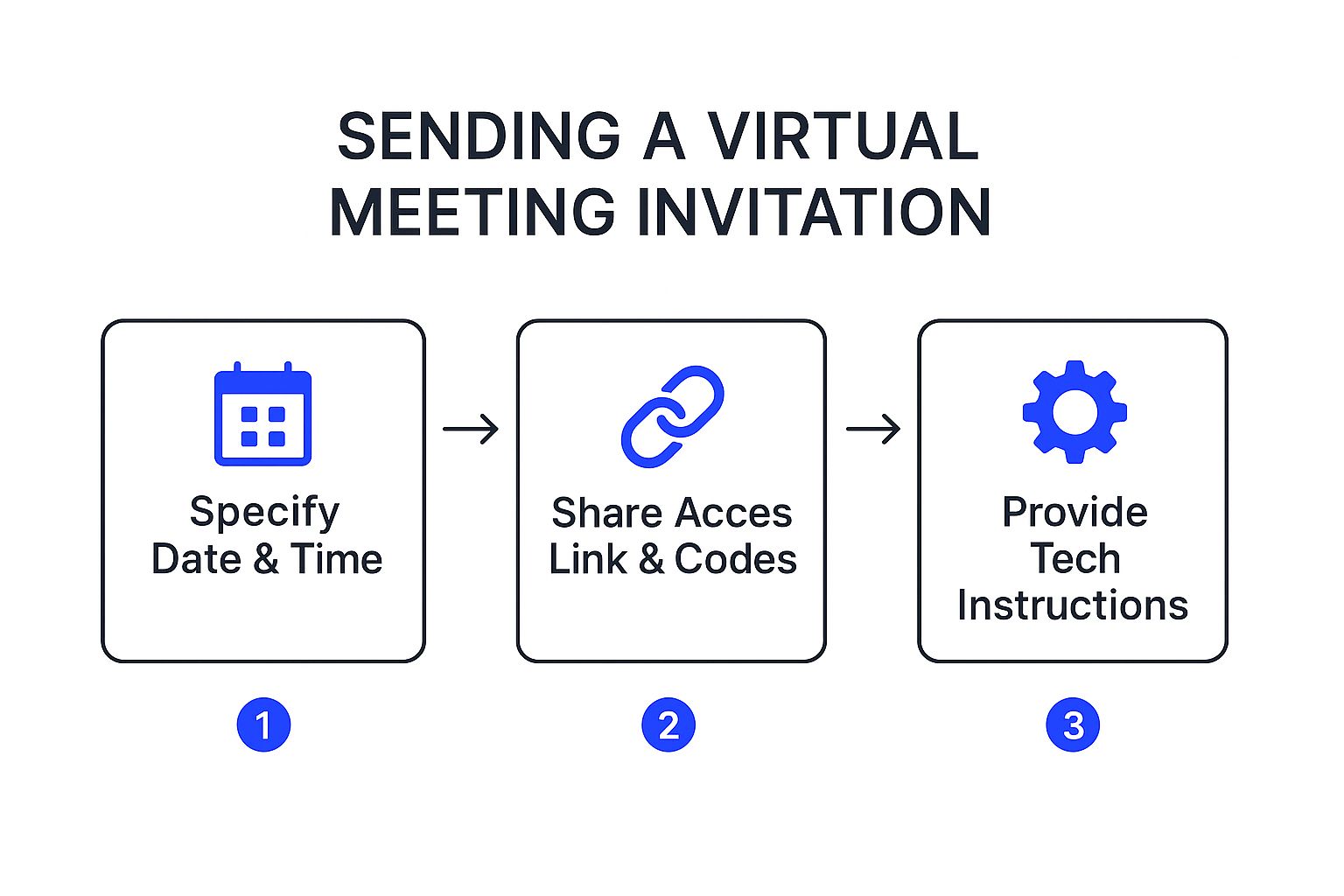 The infographic illustrates the key steps involved in preparing for and joining a virtual meeting, emphasizing the flow of information from invitation to successful participation.
It starts with sending the invitation email with all the necessary details, followed by pre-meeting preparation by the attendees, then joining the meeting using the provided links and instructions, and finally, active participation in the virtual meeting.
The visual representation clarifies the process and highlights the importance of each step in ensuring a smooth and effective online meeting.
This template distinguishes itself from generic meeting invitations by its emphasis on technical clarity and preparation. Key features include prominently displayed video conference links and access codes, detailed technical requirements and setup instructions, a defined method for distributing digital materials, guidelines for virtual meeting etiquette, and clear time zone information for global participants.
Example:
Subject: Virtual Strategy Workshop - Join us on Zoom, Sept 5th @ 1pm ET
Hello everyone,
You're invited to our upcoming Virtual Strategy Workshop taking place on Thursday, September 5th from 1:00-2:30pm Eastern Time (10:00-11:30am Pacific, 6:00-7:30pm London).
📅 Meeting Details:
• Date: Thursday, September 5th, 2023
• Time: 1:00-2:30pm ET (Check your local time: timeanddate.com/worldclock/converter.html)
• Platform: Zoom
• Meeting Link: https://zoom.us/j/123456789
• Meeting ID: 123 456 789
• Passcode: strategy2023
• Dial-in option: +1 555-123-4567🔧 Technical Setup:
• Please test your audio/video before joining: zoom.us/test
• Update your Zoom application for the best experience
• Use headphones if possible to reduce background noise📝 Preparation:
• Review the attached briefing document
• Complete the pre-workshop survey: [Link]
• Prepare to share your screen if presentingIf you have any technical difficulties joining, please text our IT support at 555-987-6543.
Looking forward to seeing you virtually!
Regards,
Taylor Chen
Workshop Facilitator
Pros: Prevents technical issues, reduces no-shows, accommodates diverse participants, and structures virtual gatherings.
Cons: Can appear overwhelming, requires updates when platform features change, and may need customization for different platforms.
Tips: Test all links before sending, include alternative joining methods, send calendar invites with embedded details, provide technical support contact, and send a reminder 1 hour before with the direct link.
This method is particularly effective for remote-first companies, organizations using video conferencing platforms like Zoom, Microsoft Teams, and Google Meet, global organizations managing international teams, and anyone organizing virtual events. It ensures a professional and organized approach to online meetings, ultimately leading to increased productivity and engagement.
This template rightfully earns its place in this list due to its targeted approach to solving the common challenges of virtual meetings, offering a sample meeting invitation email that is both comprehensive and user-friendly. It’s particularly valuable for business professionals, sales and marketing teams, customer support staff, freelancers, entrepreneurs, and event organizers seeking to optimize their online communication.
5. Executive Briefing Meeting Invitation Template
This template focuses on crafting high-impact, concise meeting invitations specifically designed for C-suite executives, board members, and other senior stakeholders. It acknowledges the time constraints of high-level executives by prioritizing clarity, strategic focus, and meticulous preparation.
This approach is ideal for meetings where critical decisions need to be made or strategic insights require dissemination at the highest organizational levels. A well-crafted sample meeting invitation email using this template can significantly improve response rates and ensure a productive meeting.
How it Works:
The Executive Briefing Meeting Invitation Template operates on the principle of respecting executive time. It delivers crucial information upfront, clearly outlining the meeting's purpose, expected outcome, and required pre-reading. This allows executives to quickly assess the meeting's value and prepare effectively.
Example:
Subject: Decision Required: Market Expansion Strategy - 30 min, Wed May 5
Dear Ms. Johnson,
We need your decision on our market expansion strategy for Q3-Q4. Our analysis shows three viable markets with different risk/reward profiles that impact our annual revenue targets by 15-20%.
Meeting Purpose: To secure your decision on which market to prioritize based on our analysis and recommendations.
When: Wednesday, May 5, 10:00-10:30 AM ET
Where: Executive Boardroom / Secure Video Link: [link]Agenda:
10:00-10:05 - Market Analysis Summary (Sarah)
10:05-10:15 - Three Market Options with Projections (Michael)
10:15-10:25 - Recommendation and Implementation Timeline (David)
10:25-10:30 - Decision and Next Steps (You)Pre-reading (5 minutes): One-page executive summary (link will be sent separately).
Please confirm your availability. If this time doesn't work, this decision needs to be made by May 7 to maintain our implementation timeline. Alternatively, I can provide a 10-minute briefing beforehand.
Respectfully,
David Chen
VP of Strategic Initiatives
Mobile: 555-123-4567
Key Features & Benefits:
Ultra-clear Subject Line: Immediately communicates the purpose (e.g., decision, review) and timeframe.
Executive Summary Upfront: Provides context and the "why" within the first few sentences.
Strategic Context and Business Impact: Connects the meeting to broader organizational goals and financial implications.
Timed Agenda with Owners: Demonstrates organized planning and accountability.
Pre-reading Materials: Equips executives with the necessary information beforehand. Note: Sending the materials separately, 24-48 hours before the meeting, can improve readability and reduce inbox clutter.
Pros:
Respects Executive Time: Brevity and focus cater to busy schedules.
Increases Acceptance Rates: Clarity and value proposition encourage participation.
Facilitates Decision-Making: Pre-reading and focused discussion prepare executives to decide.
Projects Professionalism: Demonstrates strategic thinking and organizational skills.
Cons:
Requires Thorough Preparation: Distilling complex information into a concise format can be challenging.
Less Effective for Brainstorming: The structured nature is less suited for open-ended or creative discussions.
Tips for Effective Implementation:
One-Screen Rule: Keep the invitation concise and easily digestible on a single screen.
Explicitly State the Desired Outcome: Clearly communicate the decision required or action expected.
Justify Executive Involvement: Explain why their presence is essential.
Offer Alternatives: Provide a shorter briefing option or a one-pager for those unable to attend the full meeting.
Why This Template Deserves Its Place:
In today’s fast-paced business environment, securing executive attention is paramount. This template provides a proven framework for crafting sample meeting invitation emails that capture executive interest, ensure preparedness, and facilitate effective decision-making. It represents a significant upgrade from generic meeting invitations, recognizing the unique demands on executive time and the need for strategic alignment.
This approach is popularized by Fortune 100 companies, management consulting firms, and executive leadership programs, demonstrating its effectiveness in high-stakes business communication.
6. Networking Meeting Invitation Template
This template focuses on building relationships and is ideal for initiating professional connections, informational interviews, or mentorship discussions. It prioritizes a balance of professionalism and authenticity, clearly articulating the value exchange for both parties, making it easier for busy professionals to accept a networking meeting invitation.
This approach recognizes that networking is about mutual benefit and building genuine connections, not just transactional asks.
How it Works:
The Networking Meeting Invitation Template hinges on demonstrating genuine interest in the recipient and their work. It begins with a personalized connection point, referencing a shared connection or a piece of the recipient's work. This establishes common ground and shows you've taken the time to learn about them. The template then clearly states the reason for connecting and proposes a specific value proposition for the recipient. Crucially, it respects the recipient's time by suggesting a short, defined meeting duration (e.g., 15-30 minutes) and offering flexible scheduling options.
Example:
Subject: Fellow Marketing Analytics Professional - Coffee Chat?
Hi Jordan,
I recently read your insightful article on attribution modeling in Marketing Today and found your approach to multi-touch attribution particularly valuable. I've implemented similar techniques at InnovateTech, where I lead digital analytics.
Would you be open to a 20-minute virtual coffee to discuss how you've handled the recent iOS privacy changes' impact on attribution? I'd be happy to share our A/B testing framework that's helped us adapt, which might be useful for your team at GrowthCo.
I understand you're busy, so I'm flexible with timing. Would any of these times work for a brief conversation?
Tuesday, Nov 14, between 8-10am PT
Thursday, Nov 16, between 3-5pm PT
Friday, Nov 17, between 11am-1pm PT
Either way, I appreciate your contributions to the analytics community.
Warm regards,
Alex Morgan
Head of Marketing Analytics, InnovateTech
LinkedIn: linkedin.com/in/alexmorgan
Twitter: @alex_analytics
Features:
Personal connection point or referral mention in the opening.
Clear articulation of the specific reason for connecting.
Value proposition for the recipient (what's in it for them).
Defined time limit (usually 15-30 minutes).
Low-pressure response options.
Pros:
Higher response rates due to personalization and respect for the recipient's time.
Creates a foundation for authentic relationship-building.
Flexible for various networking contexts (career advice, partnership exploration, etc.).
Sets proper expectations for both parties.
Cons:
Requires research to personalize effectively.
May need follow-up to secure a response.
Tone must be carefully balanced to avoid appearing transactional.
Tips:
Research the person thoroughly before reaching out (recent articles, social posts, company news).
Mention a specific piece of their work that resonated with you.
Clearly state what you can offer them (not just what you want).
Keep the time request short (15-30 minutes maximum for an initial meeting).
Provide flexible scheduling options but with specific times.
Always include a graceful 'out' if they're too busy.
When and Why to Use This Approach:
This template is highly effective when your goal is to build genuine professional relationships, learn from experienced individuals, explore potential collaborations, or seek career advice. It's particularly useful for reaching out to busy professionals who are more likely to respond to personalized and value-driven requests. This method deserves its place on this list because it prioritizes building authentic connections, which is the core of effective networking.
Popularized By: Networking experts like Keith Ferrazzi and Adam Grant, professional platforms like LinkedIn, career coaches and mentorship programs, and books like Never Eat Alone and Give and Take. This template exemplifies the principles these resources advocate. This approach is invaluable for business professionals, sales and marketing teams, customer support staff, freelancers, entrepreneurs, and event organizers looking to expand their network meaningfully. Using a sample meeting invitation email like this drastically improves the chances of a positive response and a fruitful networking interaction.
7. Follow-Up Meeting Invitation Template
A critical component of effective communication and project management is the follow-up meeting. This is where momentum is maintained, progress is tracked, and relationships are solidified. A well-crafted follow-up meeting invitation email is essential to ensure these meetings are productive. This template focuses on scheduling subsequent meetings after an initial conversation, leveraging established context to drive projects and relationships forward. A sample meeting invitation email for a follow-up should always connect past discussions with planned future actions.
This template distinguishes itself from a standard meeting invitation by explicitly building upon a previous interaction. It serves as a valuable tool for various professionals, including those in sales, project management, customer success, and anyone managing ongoing projects or client relationships.
Features:
Reference to previous meeting/conversation: Including the date and time of the previous interaction anchors the follow-up in a shared history, reminding participants of the ongoing conversation.
Summary of key points or decisions: Recapitulating key takeaways and decisions from the prior meeting refreshes everyone's memory and provides essential context for the upcoming discussion.
Clear objectives for the follow-up session: Defining the goals of the follow-up meeting ensures everyone understands the purpose and expected outcomes.
Action items or preparation needed: Listing pre-meeting tasks ensures participants arrive prepared, maximizing the meeting's effectiveness.
Continuity elements: Maintaining a consistent tone and format between the initial and follow-up invitations fosters a sense of continuity and professionalism.
Pros:
Creates continuity in professional relationships
Refreshes everyone's memory about previous discussions
Demonstrates organization and follow-through
Sets clear expectations for progress
Cons:
Requires good documentation of previous conversations
Less effective if too much time has passed since the initial meeting
May need customization based on how the first meeting concluded
Example:
Subject: Next Steps on Website Redesign Project - Follow-Up Meeting
Hi Design Team,
Following our productive kickoff meeting on October 3rd, I'd like to schedule our next session to review the initial wireframes and discuss the content migration strategy.
As agreed, Maria has completed the user persona documentation and Jacob has prepared the preliminary site architecture for our review (both attached).
Proposed Follow-Up Meeting:
• Date: Thursday, October 19
• Time: 2:00-3:30pm EST
• Location: Design Lab / Zoom Link: [link]
Agenda:
Review wireframes for homepage and product pages (30 mins)
Discuss content migration timeline and responsibilities (30 mins)
Address open questions from kickoff meeting (15 mins)
Confirm next milestones and assignments (15 mins)
Before the meeting, please:
Review the attached user personas and site architecture
Come prepared with feedback on the initial wireframes (shared in Figma)
Think about resource needs for the content migration phase
Please confirm your attendance by EOD tomorrow. If you can't make it, let me know your key input on the wireframes in advance.
Thanks for your continued collaboration,
Robin
Project Manager
Tips:
Always reference specific details from the previous meeting to show attentiveness.
Include a brief summary of decisions already made to maintain context.
Clearly state what progress is expected between meetings.
Attach or link to any documents discussed in the previous meeting.
Keep a consistent format between the initial and follow-up meeting invitations.
When and Why to Use This Approach:
This template is particularly valuable when managing projects, nurturing client relationships, or following up on sales conversations. It ensures all parties are aligned, informed, and working towards shared goals. It also reinforces professionalism and demonstrates a commitment to follow-through.
This template's emphasis on context and continuity makes it a powerful tool for driving progress and strengthening professional relationships. Its structured approach helps ensure that follow-up meetings are productive and contribute meaningfully to achieving overall objectives. This method deserves its place on this list because it addresses the specific needs of ongoing communication, going beyond simply scheduling another meeting and focusing on fostering productive collaboration.
This is invaluable for business professionals, sales and marketing teams, customer support staff, freelancers, entrepreneurs, and event organizers alike who need to manage projects and maintain client relationships effectively. This ensures everyone is on the same page and understands the next steps, contributing to a more efficient and collaborative workflow. Creating a sample meeting invitation email for a follow-up meeting can greatly improve productivity and communication.
7 Meeting Invitation Email Templates Comparison
Template | Implementation Complexity 🔄 | Resource Requirements 💡 | Expected Outcomes 📊 | Ideal Use Cases 💡 | Key Advantages ⭐ |
|---|---|---|---|---|---|
Formal Business Meeting Invitation | Medium - requires careful wording and formality | Moderate - time for detailed content and proofreading | Clear communication of logistics and professionalism | High-stakes corporate meetings, executive/client interactions | Projects professionalism; sets serious tone; reduces ambiguity |
Casual Team Meeting Invitation | Low - quick, informal language | Low - minimal preparation, informal tone | Builds team rapport and encourages participation | Internal team syncs, creative environments, collaborative sessions | Fosters engagement; easy to personalize; fast to write |
Client Meeting Request | Medium - needs personalization and scheduling options | Moderate - requires client research and calendar management | Higher response & meeting acceptance rates | Sales, consulting, service-based businesses dealing with clients | Client-focused; flexible scheduling; shows preparation |
Virtual Meeting Invitation | Medium to High - includes technical details and instructions | Moderate to High - requires platform details, links, and support info | Reduced tech issues and improved attendance | Remote meetings, cross-timezone teams, virtual events | Prevents confusion; supports global participants; reduces no-shows |
Executive Briefing Meeting Invitation | High - concise, strategic, with pre-reads | High - significant prep and strategic summaries | Efficient decision-making and executive buy-in | Meetings with C-suite, board members, strategic discussions | Respects time with focus; increases acceptance; supports decisions |
Networking Meeting Invitation | Medium - personalized and value-driven | Moderate - requires detailed research and tailored messaging | Builds authentic professional relationships | Networking, mentorship, informational interviews | High response via personalization; sets clear expectations |
Follow-Up Meeting Invitation | Low to Medium - references previous meeting | Low to Medium - needs documentation and summary | Maintains momentum and relationship continuity | Post-initial meetings, project updates, ongoing collaboration | Ensures continuity; refreshes context; drives progress |
Elevate Your Email Game with Quiky.email
This article explored seven essential sample meeting invitation emails, covering various scenarios from formal business meetings and client interactions to casual team check-ins and virtual gatherings.
Mastering the art of crafting compelling invitations is crucial for ensuring high attendance rates and setting the stage for productive meetings.
Creating effective meeting invitations often involves designing clear and concise forms for attendees to RSVP or provide necessary information. For insights on optimizing forms for better user experience and completion rates, check out this resource on form design best practices.
Your next step is to put these templates and best practices into action. Analyzing your upcoming meetings and choosing the appropriate template – whether it's for a follow-up discussion or a crucial client presentation – will immediately enhance your communication strategy.
By implementing these sample meeting invitation emails, you'll not only save valuable time but also project professionalism and ensure that your meetings are well-attended and productive.
Tired of painstakingly drafting each invitation? Quiky.email empowers you to generate professional, personalized sample meeting invitation emails in mere seconds. From automated reminders to streamlined scheduling, Quiky.email's AI-powered tools free you to focus on what truly matters: achieving your meeting objectives and driving business growth. Explore Quiky.email today and transform your communication workflow. Invest in the power of effective communication and watch your meetings – and your business – thrive.
Key Takeaways
Essential learnings that you should remember from this article
- Understand the importance of tailoring your meeting invitation style to the audience and context.
- Learn the key components of effective meeting invitations, including clarity, professionalism, and personalization.
- Recognize the common pitfalls in meeting invitations and how to avoid them for better engagement.
Practical Tips
Actionable tips you can apply immediately to improve your email performance
Use Clear Subject Lines
Always include a specific and informative subject line that reflects the meeting's purpose and date.
Include All Necessary Details
Ensure your invitation contains date, time, location (or link), agenda, and RSVP instructions to avoid confusion.
Tailor Your Tone
Adjust the formality of your invitation based on the audience—formal for executives, casual for team meetings.
Common Mistakes to Avoid
Pitfalls and misconceptions to avoid when writing persuasive emails
- Using vague subject lines that do not convey the meeting's purpose.
- Failing to include essential details like time zones or meeting links for virtual gatherings.
- Not personalizing invitations for clients or key stakeholders, which can lead to lower response rates.
Tools to Apply These Concepts
Put what you've learned into practice with these specialized tools
Related Content
Continue exploring with these related articles and tools